Lively Tales About Dead Teams

Archive for the ‘CHL 1963-1984’ tag

December 9, 1977 – Phoenix Roadrunners vs. Fort Worth Texans

leave a comment

Phoenix Roadrunners vs. Fort Worth Texans
December 9, 1977
Veterans Memorial Coliseum
Central Hockey League Programs

The Phoenix Roadrunners brand has been used by no less than five separate pro hockey organizations operating in Phoenix, Arizona between 1967 and 2009.

The original Roadrunners came to Arizona in 1967 as members of the minor Western Hockey League (1952-1974).  The Roadrunners won a couple of Western League titles in the early 1970′s and then jumped up to the World Hockey Association in 1974 after the WHL went out of business.  The World Hockey Association brought true major league hockey to Phoenix for the first time – a worthy rival to the caliber of play in the National Hockey League.  The original Roadrunners lasted three seasons in the WHA but folded under financial strain in the spring of 1977.

A local Roadrunners fan named Mike Leonard quickly secured the rights to the Roadrunners name and logo.  Leonard started a new Roadrunners team in the minor Central Hockey League during the summer of 1977 and persuaded the NHL’s Cleveland Barons and Colorado Rockies to designate Phoenix as their top farm club.  Sandy Hucul, a popular former Roadrunners player and coach who was fired by the previous ownership in 1976, was brought back to coach the new club.

The “new” Roadrunners were terrible, just like their parent clubs in Cleveland and Denver.   By early December, the ‘Runners had a record of 4-20-3.  Mike Leonard’s relationship with CHL officials deteriorated rapidly.  This December 9th, 1977 program is from one of the Roadrunners’ final nights in the Central League.  Three days later on December 12th, 1977 Leonard pulled the club out of the CHL, complaining that the league made it impossible for Phoenix to field a competitive team.   Rather than fold, Leonard immediately entered the Roadrunners into the Pacific Hockey League, a new independent outfit organized by World Hockey Association founder Dennis Murphy and San Diego Sports Arena owner Peter Graham.  The Roadrunners went onto play 42 more games that winter as members of the PHL.  The Roadrunners played one more full season (1978-79) before folding along with the rest of the Pacific League in 1979.

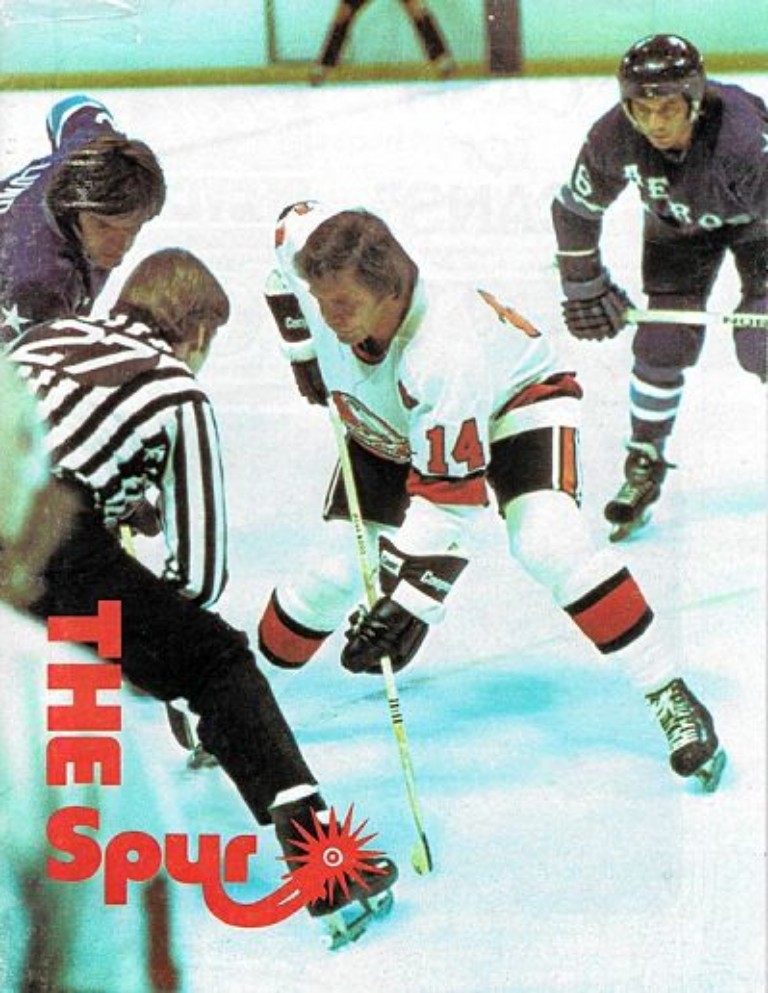
Bjorn Johansson of the Roadrunners is pictured in the cover illustration for this evening’s game program.  The Swedish defenseman was an infamous draft bust, a top ten overall selection in both the NHL and World Hockey Association drafts in 1976.  He would appear in just 15 NHL games with the Cleveland Barons between 1976 and 1978, scoring two points and logging a minus-13.  He went back to Sweden in 1978 and finished his career quietly in 1981.

##

The Roadrunners were revived again in 1989 as an entry in the ambitious International Hockey League, a minor league with team stretched from Manitoba to Florida.  This third incarnation of the Roadrunners lasted eight seasons, folding in 1997.

A fourth version of the Roadrunners played in the ECHL from 2005 to 2009.


Written by andycrossley

December 9th, 2012 at 10:40 pm

October 24, 1979 – Cincinnati Stingers vs. Dallas Black Hawks

leave a comment

Cincinnati Stingers vs. Dallas Black Hawks
October 24, 1979
Riverfront Coliseum
Central Hockey League Programs

The Cincinnati Stingers hockey team began life in the upstart World Hockey Association in the winter of 1975-76.  Owners Bill DeWitt Jr. and Brian Heekin originally set out to get an NHL expansion club for the Queen City, failed, and then accepted the first expansion franchise awarded by the fledgling WHA as a fallback option in May 1973.  The hockey team was mothballed for two years as Dewitt Jr. and Heekin worked to finance and build Riverfront Coliseum.  The arena finally opened in September 1975 with the Stingers as its primary tenant.

Meanwhile, the WHA and the NHL were embroiled in a costly arms race for talent.  Serious merger talks began in 1976.  In the summer of 1977, a merger agreement was hammered out that would see the Stingers join the NHL in the winter of 1977-78, but the measure failed by a single vote when put to the NHL owners, many of whom still harbored enormous ill will towards the WHA owners for putting an end to their monopoly and driving up salaries.

It took two years to get the parties back to agreement, during which time the WHA contracted to only six teams.  The Stingers were always a somewhat weak entry in the league, losing in excess of $1 million in each of their four WHA seasons from 1975 to 1979.  The club nearly folded in the summer of 1978 before issuing a ticket sales ultimatum to the public through the Chamber of Commerce and the Office of Mayor Jerry Springer (yes, that Jerry Springer).  When the 1979 NHL-WHA merger finally went through, the Stingers were left out.  The WHA’s four eldest clubs – the Edmonton Oilers, New England Whalers, Quebec Nordiques and Winnipeg Jets – were accepted into the NHL but forced to pay $6 million expansion fees.  The WHA’s weaker sisters – the Stingers and the Birmingham Bulls – were paid to go away.  DeWitt and Heekin accepted a reported buyout of $3.15 million.

Both Cincinnati and Birmingham then re-formed as minor league franchises in the Central Hockey League for the 1979-80 season.  The Stingers would serve as a shared farm club for the Jets, Nordiques, Oilers and Whalers, receiving prospects and backstop for any financial deficits from the four former WHA clubs that made the leap to the NHL.

But after four years of top flight WHA competition, Cincinnati hockey fans had little use for the CHL, or for the Stingers’ humiliating new status as a lowly farm club for their own former rivals.  Fewer than 20,000 fans turned out for the Stingers first 16 home dates at the Riverfront Coliseum.  Saddled with an unpopular minor league club paying big city rent at the Riverfront Coliseum, the Stingers’ NHL paymasters quickly grew unhappy with the arrangement:

“I’m not in business to support hockey for the citizens of Cincinnati, and I don’t think they would expect it of me,” Edmonton Oilers owner Peter Pocklington told The Associated Press.  “When you are drawing 800 or 900 people to the games, it’s obvious you are losing a lot of money.  My patience is wearing pretty thin.”

By December, it was clear the team could not go on.  The end came in ignominious fashion on December 18th, 1979, with the Stingers getting blasted 10-1 by the visiting Oklahoma City Stars on a dreary Tuesday night at the Coliseum.  Only 949 fans bothered to show.  Stingers officials announced the team was out of business effective immediately as soon as the final siren sounded.

CHL Commissioner Bud Poile blamed “the highest hockey rent in the world” at Riverfront (a reported $7,300 per game per The Associated Press) for the Stinger’s untimely demise, adding: “I hope it hasn’t killed hockey in the area.”

It didn’t.  Strangely, the CHL took another crack at Cincinnati less than two years later.  But the Cincinnati Tigers lasted only a single season at Riverfront Coliseum in the winter of 1981-82 before they too folded.  The Central Hockey League itself followed not long afterwards, closing up shop in May 1984.

A few pieces of late-era Stingers trivia:

  • The Stingers folded on December 18, 1979  with a  11-21-1 record after playing 33 games of an intended 80 game schedule.
  • Stingers leading scorer Bernie Saunders (13 goals, 11 assists) is the brother of ESPN anchor John Saunders.  He appeared in four games with the Quebec Nordiques during the 1979-80 season, becoming only the 5th black player to skate in the NHL.

Downloads:

10-24-79 Stingers vs. Black Hawks Sources

Written by andycrossley

August 4th, 2012 at 12:59 pm

January 2, 1971 – Kansas City Blues vs. Amarillo Wranglers

leave a comment

Kansas City Blues vs. Amarillo Wranglers
January 2, 1971
American Royal Arena
Central Hockey League Programs
38 pages

I love the look of this old program from the Central Hockey League (1963-1984).  To my mind, the 1970′s was the Golden Era for illustrated programs like this one.  The Kansas City Blues were a farm club of the NHL’s St. Louis Blues from 1967 to 1972.  They played in the American Royal Building, a 6,100-seater named for the annual American Royal livestock show that ran each autumn.

The top player in this game was Curt Bennett, a 22-year old left winger for the Blues in his first year of pro hockey during the winter of 1970-71.  Although Bennett was born in Saskatchewan to a Canadian father, he was raised in Rhode Island and attended Brown University.  In the 1974-75 season, he scored 31-goals for the Atlanta Flames and earned his first of two invitations to the NHL All-Star Game.  He is often referred to as the first American (or first “American-bred”) player to score 30 goals in a season in the NHL.

The Blues left Kansas City after the 1971-72 season.  After the construction of Kemper Arena in 1974, the NHL came to town with the Kansas City Scouts, who lasted only two seasons before leaving for Denver.  After the NHL departed, the Kansas City Blues were revived as a CHL franchise and St. Louis farm club for the winter of 1976-77 at Kemper Arena.  After one season, the team switched its affiliation to the Detroit Red Wings and was known as the Kansas City Red Wings for the final two years of its existence.  The Red Wings folded in 1979 and the CHL itself went out of business five years later in the summer of 1984.

The Blues’ opponent on this evening was the Amarillo (TX) Wranglers, an obscure and short-lived farm club of the Pittsburgh Penguins.  The Wranglers first set-up shop in Amarillo in the winter of 1968-69, but shut down after one season due to poor attendance and financial losses.  In an unusual move, Penguins founder Jack McGregor returned to Amarillo just one year later and re-established the Wranglers for the 1970-71 season.  But the financial outlook for the club didn’t improve and the Wranglers would fold for the second and final time in the spring of 1971.

Written by andycrossley

April 10th, 2012 at 2:13 pm

1980-1984 Wichita Wind / Montana Magic

2 comments

Former World Hockey Association executive and Edmonton Oilers General Manager Larry Gordon founded the Wichita Wind of the Central Hockey League in June of 1980.   Gordon was quite familiar with the Central League.  During the 1979-80 NHL season, Gordon managed the Oilers’ contentious relationship with the Houston Apollos, their first-year farm club in the Central League, and represented the Apollos on the CHL’s executive committee.  In March 1980, Gordon orchestrated the removal of Apollos Head Coach Al Rollins and replaced him with Garnet “Ace” Bailey, a 31-year old former Oilers player who had been languishing on the bench under Rollins.

Meanwhile, Gordon’s influence on Edmonton’s NHL hockey operations was on the wane, as Head Coach Glen Sather consolidated his authority over player personnel decisions for the Gretzky-era Oilers.  In the spring of 1980, Gordon left the Edmonton organization with a couple of years left to run on his contract in order to purchase a new Wichita, Kansas franchise in the Central League.  He brought a few things with him from Houston, including the affiliation deal with the Oilers and his hand-picked Head Coach, Ace Bailey.

The city of Wichita caught Gordon’s eye after a crowd of 8,000 turned out at the city’s Kansas Coliseum to watch a U.S. Olympic team tune-up game  prior to the 1980 Olympics at Lake Placid.  That event turned out to be something of a siren song for Gordon – his own experience in Wichita proved much different.  The Wind averaged 971 fans per game in November 1980, 1,537 in December and 1,600 in January 1981.

I cry a lot,” Gordon joked to long-time Edmonton Oilers beat writer Jim Matheson in February 1981, “At worst I thought I might lose $150,000…but it’ll be closer to $350,000.”

The Matheson interview also indicates that Gordon, the hockey traditionalist, underestimated the competition for the entertainment dollar that he faced from the Wichita Wings of the upstart Major Indoor Soccer League, another winter time tenant at the Kansas Coliseum.  In their second season of operation in 1980-81, the Wings were the city’s hot ticket drawing close to 6,000 fans per game.

Of the seven CHL clubs that finished the 1980-81 season (two folded midway), the Wind finished in 6th place with a 32-45-3 record.  But Bailey’s club made an inspired run through the playoffs, when a fallen NHL phenom named Don Murdoch put the club on his back and carried it all the way to the Adams Cup final.  Murdoch was the first round draft choice of the New York Rangers in 1976.  The 20-year old made the club out of training camp and scored five goals in his fourth NHL game.  As a rookie, he scored 32 goals in 59 games before an ankle injury ended his season.  Drug and alcohol problems, particularly a 1977 cocaine bust that resulted in a 40-game suspension for the 1978-79 season, ensured that Murdoch never achieved the stardom he seemed destined for.  But in the 1981 CHL playoffs, the 24-year old dominated,  scoring a remarkable 17 goals and and 7 assists in 18 games to fuel Wichita’s unlikely run.

In the Adams Cup final, the Wind took the Salt Lake Golden Eagles to the limit before dropping the seventh and deciding game 5-2 on May 18, 1981.

For the 1981-82 season, long-time minor league coach John Muckler joined the Oilers organization and took over the coaching reigns in Wichita from Ace Bailey, who moved into the Oilers scouting department.  Under Muckler, the Wind finished first in the CHL’s five-team Southern Division with 44-33-3 record.  Along the way Muckler and eight of his players grabbed some Slap Shot-style national press coverage, spending the night in a Dallas jail following a scuffle at a country & western disco while on a Texas road trip.

As the Wind headed into the their third season in the fall of 1982, the complexion of the club changed dramatically.  The Edmonton Oilers, emerging as a dynasty in the NHL, departed as the parent club, replaced by the sad sack New Jersey Devils, one of the NHL’s worst teams.  After winning the CHL’s Southern Division in 1981-82 and advancing to the 1982 Adams Cup semi-final, the 1982-83 Wind dropped to a last place in the league with a 29-48-3 record.  Attendance dropped nearly 40% from approximately 3,000 per game in 1981-82 to 1,800 for the 1982-83 season.  At the end of the season, Gordon announced he would move his club out of Wichita due to lack of a practice facility and a disagreement over new lease terms at the Kansas Coliseum.

Don Murdoch

In April 1983, Gordon signed a letter of intent to move the Wind to the 8,700-seat Yellowstone METRA in Billings, Montana.  The Central League approved the transfer during annual meetings two months later in June 1983.  In line with the move, Gordon sought additional investors, selling a 40% stake in the club – now renamed the Montana Magic – to the Ermineskin Indian Band of Alberta, Canada for $400,000.

The New Jersey Devils shifted their affiliate to Portland, Maine of the American Hockey League during the summer of 1983, so Gordon struck a new working agreement with the NHL’s St. Louis Blues to help stock the Magic for the 1983-84 CHL season.  While the Blues would pay their prospects’ salaries, the Magic also signed a half dozen or so independent players – free agents that would be paid by Gordon’s local management.  Among the independents was Reggie Leach, the Canadian aboriginal sniper and Philadelphia Flyers cult hero who set an all-time NHL record with 80 goals during the 1975-76 regular season and playoffs.  In the fall of 1983, the 33-year old ”Riverton Rifle” was only three years removed from his last 50-goal campaign in the NHL.  Midway throught the season, the Magic got Don Murdoch back, the can’t miss superstar turned minor league journeyman who had followed Larry Gordon from Edmonton to Wichita to Montana.

The 20-year old Central Hockey League staggered into the 1983-84 season with only five active franchises.  The league incorporated twenty Olympic warm-up matches against the U.S. and Canadian Olympic teams into the regular season standings to help round out the schedule.  NHL President John Ziegler cited the CHL’s sprawling geography – Billings was 1,200 miles from Indianapolis and 1,000 miles from Tulsa – as one of the league’s Achilles heels in a 1984 interview with Dave Molinari of The Pittsburgh Press:

“One of the problems in the Central League is the tremendous distance involved in moving teams from one place to another.  That imposes a cost burden which, in these days, has become very disproportionate to the kind of attendance dollars generated.  Now you hear of a team that may lose $750,000, $800,000 or a million dollars a year and produce from that operation – if they’re lucky – one player a year.  That player becomes a very expensive commodity.”

Pat Rabbitt – 1983/84 season

In mid-February 1984, the Tulsa Oilers ownership ran out of money and abandoned the club.  The Oilers were forced to finish the season as a travel team, playing on the road as wards of the league.  The Magic were next.  By early March, Gordon’s group could no longer fund the club’s payroll.  The Magic were forced to postpone a March 6th game against the Colorado Flames when the St. Louis Blues recalled five of their players and six unpaid independents refused to play, including Leach.  The Ermineskin Indian Band stepped up again, buying out Gordon and increasing their ownership stake in the Magic from 40% to 77.5%.  This infusion allowed the Magic to complete their 76-game season, finishing in last place with a 20-52-4 record.

On May 21st, 1984 the Central Hockey League voted to dissolve after 21 seasons, bringing the brief tenure of the CHL in Montana to an end.

##

Wind goaltender Andy Moog (1980-1982) went on to play a major role in three Stanley Cup victories for the Edmonton Oilers in 1984, 1985 and 1987.

John Muckler left the Wind after the 1981-82 season, when Edmonton dropped its affiliation with Wichita.  He served as an assistant and co-Head Coach to Glen Sather on the 1984, 1985 and 1987  Oilers Stanley Cup championship teams.  He took over head coaching reigns for the 1989-90 season and directed the Oilers to the club’s only Stanley Cup victory without Wayne Gretzky.

Original Wind Head Coach Garnet ”Ace” Bailey went on to become a highly respected scout in the Oilers and Los Angeles Kings organizations.  He was killed on September 11th, 2001 as a passenger aboard United Airlines Flight 175 that crashed into the World Trade Center.

Downloads and Further Reading:

Wichita Wind All-Time Roster at Hockeydb.com
1983-84 Montana Magic statistics at Hockeydb.com
Wichita Wind – Montana Magic Sources


Written by andycrossley

June 12th, 2011 at 12:39 am