Lively Tales About Dead Teams

Archive for the ‘NASL’ tag

1979-1981 Atlanta Chiefs

leave a comment

North American Soccer League (1979-1981)

Born: August 1978 – The Caribous of Colorado relocate to Atlanta, GA.
Died: September 27, 1981 – The Chiefs cease operations.

Stadium: Atlanta-Fulton County Stadium (52,522)

Arena: The Omni

Team Colors: Red, White & Blue

Owners: Dick Cecil, Al Thornwell, Ted Turner


A rare misfire for sports & media mogul Ted Turner.  This 1979-1981 edition of the Atlanta Chiefs pro soccer team was actually a resurrection of an earlier club, also known as the Atlanta Chiefs, that played in the city from 1967 to 1972.  Both editions of the Chiefs were tied into the Major League Baseball’s Atlanta Braves through common ownership (hence the Native American-themed identity).

Braves ownership was in different hands by the time the 1979 edition of the Chiefs came into being. (Turner bought the Braves in 1976).   The common thread and spiritual leader of both Chiefs teams was a man named Dick Cecil.  Cecil was a Vice President of the Braves when the World Cup was broadcast in the United States for the first time in 1966 and took an interest in the sport.  Cecil was instrumental in forming the National Professional Soccer League in 1967 and in the worldwide search for player talent for the early Chiefs teams of the 1960′s.  One of Cecil’s key early hires was South African Phil Woosnam as Head Coach & General Manager.  Woosnam led the Chiefs to the first championship of the North American Soccer League in 1968.

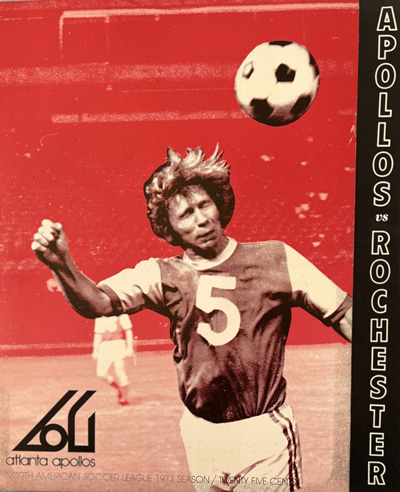
The original Chiefs changed hands in 1973, sold to the owners of the Atlanta Hawks, who renamed the team the Apollos.  The Apollos folded after one year and Atlanta was without pro soccer for five seasons.  No one seemed to object.  But by 1978 the NASL was on an upsurge, fueled by the excitement around the New York Cosmos and their stable of international superstars and an expansion surge that would see the league swell to 24 clubs by 1980.  Cecil formed a group with Braves investors Al Thornwell and Ted Turner to purchase the NASL failing Colorado Caribous franchise and move it to Atlanta-Fulton County Stadium for the 1979 season.

The “new” Chiefs were a box office flop in Atlanta.  The team fared poorly in 1979 under Head Coach Dan Wood, a holdover from the Caribous days, finishing at 12-18.  Average attendance of 7,350 ranked 20th among the NASL’s 24 clubs.  A bright spot was English striker Jeff Bourne, who finished 4th in the NASL in scoring in 1979 with 18 goals and 15 assists.

The 1980 season was even worse.  Wood was fired midway through the season.  The Chiefs finished with the league’s worst record (7-25), limpest offense (34 goals in 32 matches) and lowest attendance (4,884 per match at 52,000-seat Atlanta Fulton-County Stadium).

Georgians clearly weren’t interested in the NASL brand of soccer – at least not the outdoor version.  But like the Memphis Rogues, another struggling club in the Deep South, it was an entirely different story when the team moved indoors for the winter.  In the winter of 1979-80, faced with competition from the upstart Major Indoor Soccer League, the NASL launched a winter-time indoor soccer season for the first time.  It was basically a short test season and only 10 of the 24 NASL clubs chose to take part.  The Chiefs were one and they set up shop at the Omni arena downtown.  Surprisingly, the Chiefs had the best record in the league (10-2) and their attendance of 5,069 for six indoor matches was better than the league average.

The 1980-81 indoor season was even better.  19 clubs participated in an expanded indoor season. Under new Head Coach David Chadwick the Chiefs tied with the Chicago Sting for the best record in the league at 13-5.  Amazingly, the Chiefs led the entire league in indoor attendance at 10,287 fans per match.  It was more than double the crowds that the Chiefs pulled outdoors the previous summer.  The Chiefs’ indoor run ended in the semi-finals at the hands of the eventual champion Sting.

The Chiefs indoor success in the winter of 1980-81 carried over to the 1981 outdoor season.  The Chiefs nearly doubled their goal scoring output from 1980′s last place campaign, thanks in large part to English striker Brian Kidd, on loan from Bolton Wanderers.  Kidd finished 3rd in the NASL with 22 goals in 1981.  The entire Chiefs team scored just 34 the year before.  The Chiefs won the Southern Division with a 17-15 record and earned their first outdoor playoff appearance.   They were eliminated by the Jacksonville Tea Men in the opening round.

The crowds didn’t follow the Chiefs outdoor from the Omni though.  The team drew only 6,189 per match in 1981, which ranked 19th among the shrinking league’s 21 clubs.  On August 21, 1981, three days after the playoff loss to Jacksonville, the Chiefs announced they were closing their doors after 3 seasons and estimated losses of $5.5M to $7.0M.  The Chiefs formally shut down one month later, the day after Soccer Bowl ’81.  They were one of seven clubs to fold after the NASL’s disastrous 1981 season.   The league itself would follow three years later, shutting down after the 1984 campaign.


==Chiefs Matches on Fun While It Lasted==

Season Date Opponent Score Program Other
1979 4/14/1979 vs. New York Cosmos L 3-2 (OT) Program Game Notes
1979 5/20/1979 @ Rochester Lancers L 2-0 Program
1979-80 2/6/1980 @ Detroit Express ?? Program
1970-80 2/23/1980 @ Tampa Bay Rowdies ?? Program
1980 8/13/1980 vs. New York Cosmos L 3-2 Program Game Notes


==Key Players==

  • Jeff Bourne
  • Paul Child
  • Brian Kidd
  • Victor Nogueira


==YouTube==

1981 Atlanta Chiefs U.S. Army commercial

Chiefs at Tampa Bay Rowdies. August 12, 1981

==Links==

North American Soccer League Media Guides

North American Soccer League Programs

###

Written by andycrossley

May 12th, 2013 at 5:39 pm

August 16, 1983 – Toronto Blizzard vs. New York Cosmos

leave a comment

Toronto Blizzard vs. New York Cosmos
August 16, 1983
Exhibition Stadium
North American Soccer League Programs
16 pages


That’s 32-year old Italian striker Roberto Bettega on the cover of this August 1983 Toronto Blizzard match program.  Bettega was perhaps the last legitimate European star to sign with the league, joining Toronto in May 1983.  By that time, the North American Soccer League was on its last legs, halved from 24 members clubs in 1980 to only 12 survivors by the start of the 1983 campaign.

Bettega played fifteen seasons for Juventus (1969-1983), helping his hometown club to seven Serie A titles and the 1977 UEFA Cup.  He also played for Italy in the 1978 World Cup in Argentina.  Just six nights before this match, Bettega’s former teammates traveled to Toronto for a friendly against the Blizzard at Exhibition Stadium.  Juventus brought seven veterans of Italy’s 1982 World Cup championship team to Toronto, including superstar Paolo Rossi.  (Bettega himself missed the 1982 World Cup due to injury).  The match drew 41,035 to Exhibition Stadium – the largest crowd ever to watch a soccer game in Toronto.  The Blizzard held the powerful Italian squad to a surprising 0-0 draw.


By contrast, the Blizzard’s return to NASL regular season action six nights later against the New York Cosmos was kind of a buzz kill.  The Cosmos were known for signing the biggest superstars in the world in the late 1970′s and they were accustomed to drawing large crowds wherever they traveled.  But by 1983, the Cosmos were deep into cost-cutting mode and it had been years since they imported a major international superstar.

A modest crowd of 11,428 showed up for a match that New York’s long-time beat writer Ike Kuhns described as “one of the dullest” of the 1983 season.  Toronto had trouble scoring all season and were playing without leading goal scorer David Byrne due to yellow card accumulation.  New York fared little better and the match went into overtime knotted at 0-0, before New York’s Steve Moyers put an apparently merciful end to the proceedings with a sudden death goal.

The notorious artificial turf surface at Exhibition Stadium was as poorly reviewed as the match itself.
“The field is just awful,” Cosmos midfielder Rick Davis told Ike Kuhns afterwards. “I still say the best thing they can do here is put up walls and play squash on it.”*


==Downloads==

8-16-1983 Toronto Blizzard Game Notes

8-16-1983 New York Cosmos Game Notes


==*Additional Sources==

“Moyers’ OT Goal Boots Cosmos By Blizzard, 1-0″, Ike Kuhns, The Newark Star-Ledger, August 17, 1983.

###

Written by andycrossley

May 10th, 2013 at 12:31 pm

1967-1968 Cleveland Stokers

leave a comment

United Soccer Association (1967)
North American Soccer League (1968)

Born: August 1966 – USA founding franchise.
Died: Postseason 1968 – The Stokers cease operations.

Stadium: Cleveland Stadium

Team Colors:

Owners:


The Cleveland Stokers were Cleveland’s first professional soccer team of real significance.   The club began play in 1967 in the United Soccer Association (USA), a league which grew up out of the enthusiasm of the 1966 World Cup.  The USA imported entire teams from Europe and South America (who were in their off-seasons during the summer months) to represent member cities.  The Stokers were actually Stoke City F.C. from England, hence the name.  Frozen foods mogul Vernon Stouffer, who also owned the Cleveland Indians at the time, was the club’s original owner.

The Stokers/Stoke City were mediocre in 1967 posting a 5-3-4 record.

Following that campaign, the Stokers merged with the rival National Professional Soccer League (NPSL) to form the North American Soccer League (NASL) for the 1968 season.  The NASL took the more conventional route of assembling rosters player-by-player, rather than importing foreign teams to play under aliases.  So Stoke City didn’t return to Cleveland for the 1968 season, although the Stokers name endured.  Much of the Stokers’ 1968 roster came from remnants of a recently disbanded NPSL team, the Philadelphia Spartans.

Meanwhile, in early 1968, Stouffer sold the Stokers to Howard Metzenbaum and Ted Bonda (future Indians owners themselves).  The team improved markedly in 1968, with a 14-7-11 record and a trip to the playoffs.  The Stokers lost to the eventual champion Atlanta Chiefs in a two-game semi-final playoff series.   A highlight of the 1968 season was a July 10, 1968 visit to Cleveland Stadium by Santos F.C. of Brazil and their international superstar Pele.  The Stokers upset Santos 2-1 before a team record crowd of over 16,000 at Cleveland Stadium.

The Stokers folded after the 1968 season as part of a massive contraction that saw the NASL shrink for 17 clubs to just 5.


==Stokers Matches on Fun While It Lasted==

Season Date Opponent Score Program Other
1968 5/11/1968 vs. Washington Whips ?? Program
1968 6/8/1968 vs. Detroit Cougars ?? Program


==Key Players==

  • Gordon Banks
  • Enrique Mateos
  • Roy Turner


==In Memoriam==

Stokers goalkeeperPaul Shardlow died of a heart attack while training on October 14, 1968.  He was 25 years old.

Original Stokers owner Vernon Stouffer died on July 26, 1974 at age 72.

Stokers striker Enrique Mateos passed away on July 6, 2001 at age 66.

1968 Stokers co-owner Ted Bonda died on October 12, 2005.

1968 Stokers co-owner Howard Metzenbaum died on March 12, 2008.  He was 90 years old.

==Links==

North American Soccer League Media Guides

North American Soccer League Programs

###

Written by andycrossley

May 8th, 2013 at 1:18 pm

1967-1968 New York Generals

leave a comment

National Professional Soccer League (1967)
North American Soccer League (1968)

Born: 1966 – NPSL founding franchise.
Died: February 18, 1969 – The Generals cease operations.

Stadium: Yankee Stadium

Team Colors: Green & Gold

Owners:


This early pro soccer entry in New York City began life in the aftermath of the 1966 World Cup, the first to be televised in the United States.  The Cup sparked a low boil gold rush to establish a proper national soccer league in the United States in 1967, with three groups competing for the honor.  Two rival leagues emerged from the negotiations.  The National Professional Soccer League (NPSL) got the all-important television contract with CBS.  The United Soccer Association (USA) received the all-important sanctioning from FIFA, which branded the NPSL as an outlaw league and threatened sanctions against players who signed with the league.

The New York Generals were originally owned jointly by broadcaster RKO General, the owner of New York’s WOR-TV Channel 9, and Wall Street investment banker Peter Elser.  The Generals played their home matches at Yankee Stadium – as did the New York Skyliners, the local entry from the rival United Soccer Association, owned by Madison Square Garden Corporation.

The Generals debuted at Yankee Stadium on April 22, 1967 against the Chicago Spurs.  A crowd of 7,766 saw the Generals triumph 2-1 thanks to goals by Luis Menotti (Argentina) and Adilson Silveira (Brazil), a pair of South Americans who joined the club just one day earlier.  For the 1967 season, the Generals finished in third place in their division at 11-13-8.

The Generals’ matches were poorly attended.  The club’s fifth home game against the California Clippers on May 27, 1967 attracted just 3,027 to Yankee Stadium on a Saturday afternoon.  Attendance was poor throughout the league and in the rival United Soccer Association as well.  In December 1967, the NPSL and the USA merged to form the North American Soccer League.   The original merger plan called for the Generals and the Skyliners to merge and form a single New York franchise for the 1968 season.   This hit a snag when RKO General decided to pull its support in January 1968.  Instead, Peter Elser decided to recruit new partners and continue the Generals on his own.  The Skyliners folded.

The highlight of the 1968 season was a July 12th visit from Santos F.C. of Brazil and their superstar striker PeleThe exhibition drew 15,645 to Yankee Stadium, with the Generals winning 5-3.  For the season, the Generals posted a winning record of 12-8-12 but again failed to qualify for postseason play.

The pro soccer bubble burst in the winter of 1968, as CBS terminated its TV contract and the NASL membership dropped from 17 clubs to just 5.  The Generals pulled the plug in February 1969, citing new league chief Phil Woosnam’s plan to import touring foreign teams to represent league cities in 1969 (a model used by the United Soccer Association in 1967) rather than allow each club to assemble its own roster.

Pro soccer returned to New York City two years later with the formation of the NASL’s New York Cosmos in 1971, a club that would captivate New York and northern New Jersey during the late 1970′s.

Notable players who wore the Generals green & gold included Menotti, who later coached Argentina to victory in the 1978 World Cup, and long-time Ajax star Co Prins.


==Generals Matches on Fun While It Lasted==

Season Date Opponent Score Program Other
1967 4/22/1967 vs. Chicago Spurs W 2-1 Program
1967 6/28/1967 @ Philadelphia Spartans ?? Program
1967 8/26/1967 vs. Philadelphia Spartans ?? Program
1968 4/21/1968 vs. Toronto Falcons ?? Program
1968   5/1/1968 vs. Baltimore Bays ?? Program
1968 6/14/1968 @ Washington Whips ?? Program


==Key Players==

  • Cesar Luis Menotti
  • Co Prins


==Links==

National Professional Soccer League Programs

North American Soccer League Media Guides

North American Soccer League Programs

###


Written by andycrossley

May 6th, 2013 at 1:14 am

June 28, 1978 – New York Cosmos vs. Los Angeles Aztecs

leave a comment

New York Cosmos vs. Los Angeles Aztecs
June 28, 1978
Giants Stadium
North American Soccer League Programs
120 pages


This late June 1978 North American Soccer League match found the New York Cosmos at the peak of their powers, both on and off the field.  Although Pele retired at the end of the 1977 season, the 1978 Cosmos were a better team without him.  They came into this match with a 15-3 record and a NASL-record 21-game home winning streak at Giants Stadium.

Their opponents were the lowly Los Angeles Aztecs (7-11, last in their division) and their American goalkeeper Bob Rigby, who happened to be pictured on the cover of the evening’s KICK Magazine match program (right).   The Aztecs were coming off a truly demoralizing week, which included the trade of disgruntled superstar George Best to the Ft. Lauderdale Strikers five days earlier and back-to-back 4-0 defeats to the Washington Diplomats and Toronto Metros-Croatia.

The Cosmos  were still a massive draw in New York and New Jersey in the summer of 1978 as well.  42,131 fans turned out for this match (on a Wednesday, no less), pushing 1978 attendance to 502,995 fans for 11 home dates.  It was the first time in the 11-year history of the NASL that a team drew over half a million fans in a single season.

The match went more or less according to script, starting with Giorgio Chinaglia putting the Cosmos up 1-0 in the 44th minute off a feed from Vladislav Bogicevic.  It was Chinaglia’s 23rd goal of the year in just 19 matches – far and away tops in the NASL.  The game would have gotten out of hand, save for the heroics of Bob Rigby, who faced 29 shots in the match and turned away several point blank chances from the Cosmos.

The Aztecs equalized in the second half when John McGrane headed in a corner from 22-year old newcomer George Dewsnip in the 49th minute.  Dewsnip was one of the two players Los Angeles received from the Ft. Lauderdale Strikers  in the George Best trade five days earlier.   But the Cosmos dominated the rest of the way.  English striker Steve Hunt - booed off the field at Giants Stadium two weeks earlier and given a two-game suspension after flipping off Cosmos fans – redeemed himself with the game winner in the 79th minute.  The Cosmos won 2-1 and extended their league-record home winning streak to 22 matches.

Two months later they would win their 2nd consecutive Soccer Bowl title.


==Downloads==

June 28th, 1978 New York Cosmos Game Notes

June 28th, 1978 Los Angeles Aztecs Game Notes

###


Written by andycrossley

April 27th, 2013 at 10:00 pm

August 6, 1977 – Washington Diplomats vs. New York Cosmos

leave a comment

Washington Diplomats vs. New York Cosmos
August 6, 1977
RFK Stadium
North American Soccer League Programs
60 pages


The mighty Pele’s professional soccer farewell tour got ugly when the New York Cosmos pulled into the nation’s capital for the regular season finale of the 1977 North American Soccer League season.

The game itself was meaningless.  The Cosmos were in the playoffs and the host Washington Diplomats were already assured of a last place finish.  But the table for a contentious match was set two weeks earlier when the Cosmos embarrassed the Diplomats 8-2 at Giants Stadium.  After that game, Cosmos forward Steve Hunt told reporters the Dips were “the worst team we’ve come across so far”.  Washington defender Jim Steele fired back in The Washington Post, promising that the Dips would “take care of Hunt” in the rematch.

The chance to see Pele’s final regular season performance drew a large crowd of 31,283 to RFK Stadium.  Cosmos manager Eddie Firmani quickly disappointed them by holding out five of his starters, including superstars Franz Beckenbauer and Giorgio Chinaglia and #1 goalkeeper Shep Messing, out of the lineup.  After the match, Firmani cited the Dips’ feisty comments in the press for the benchings, claiming “I had to protect my players”.  Diplomats President Steve Danzansky, looking out at the second largest soccer crowd in Washington’s history, was enraged and grumbled to the press about filing a protest with the league.

More likely, Firmani was resting his stars for the playoffs, since he left the one player that the Dips really wanted a piece of – Steve Hunt – in the starting line-up.  The match was chippy from the start, according to Post scribe John Feinstein, with several Dips going after Hunt in the first half.  English forward Jimmy Redfern staked the lowly Dips to a surprising 2-0 lead with a brace in the first half.

Pele cut the Washington lead in half by converting a penalty in the 36th minute.  Just before the half, the teams tussled in the Washington end after a hard foul by Dips defender Alex Pringle.  Hunt went after Pringle.  Pele jumped into the mix as well, laying out Washingtos Mike Lester with a left hook.  Pele managed to avoid ejection from his last regular season match, but Hunt and Pringle were tossed, as was Dips defender Ray Willner, carder for kicking a Cosmos player.

After the fracas, the Dips had to defend their 2-1 lead while playing a man down for the second half.  Washington goalkeeper Eric Martin was spectacular, making 11 saves including numerous point-blank shots by the New Yorkers.

The feisty match salvaged some pride for the Diplomats, who were done for the season.  Three weeks later, the Cosmos defeated the Seattle Sounders 2-1 to win Soccer Bowl ’77 in Pele’s final competitive game.


==Downloads==

8-6-1977 Washington Diplomats vs. New York Cosmos Game Notes

1977 “Dips Tips” Soccer Brochure

1977 Washington Diplomats Media Guide Late Additions

Article Sources

###


Written by andycrossley

April 24th, 2013 at 7:24 pm

September 8, 1979 – Soccer Bowl ’79 – Vancouver Whitecaps vs. Tampa Bay Rowdies

leave a comment

Vancouver Whitecaps vs. Tampa Bay Rowdies
Soccer Bowl ’79
September 8, 1979
Giants Stadium
North American Soccer League Programs
112 pages


It was a disgruntled crowd of 50,669 that turned out at the Meadowlands on September 8, 1979 for Soccer Bowl ’79, the title match of the North American Soccer League.  The actual ticket sales reportedly exceeded 66,000, but nearly 25% of the crowd stayed home, despite nice weather.  Perhaps they were still disgruntled over the events of a week prior.  Local fans of the two-time defending champion New York Cosmos had plenty of reasons to expect their club to enjoy home field advantage in the final.  They were accustomed to having the best and highest paid team in theNASL and the Cosmos steamrolled through the 1979 regular season with a 24-6 record.

But exactly one week earlier, the Vancouver Whitecaps came into Giants Stadium and stunned the Cosmos, eliminating the New Yorkers on their home turf in the second leg of a two-game Semi-Final series.  Among those graying elders who loved the NASL, the second leg of the 1979 Cosmos-Whitecaps semi-final is considered one of the greatest games ever played in the NASL.  The Whitecaps took the first leg by a score of 2-0 three nights earlier in Vancouver.  Cosmos defender Andranik Eskandarian got a red card for a hard foul on Vancouver’s Kevin Hector with less than 10 seconds left in the match, suspending him for the second leg.  After the match, superstar defender Carlos Alberto accosted game officials over a non-call and allegedly spit at the linesman.  NASL Commissioner Phil Woosnam immediately suspended Alberto for the rest of the season.  To Cosmos fans, it was the ultimate bag job – sure evidence that the league wanted somebody else to win for once.  Cosmos officials were livid as well.  They threatened to sue Woosnam and the league.

To advance to Soccer Bowl ’79, the Cosmos would need defeat the Whitecaps at home in the second leg, and then win a 30-minute “Mini-Game” to break the 1-1 split in games.  This was due to the NASL’s obsession with avoiding draws of all types.   In fact, the second leg of the series would finish in a draw, as the Whitecaps secured a 2-2 result in regulation, thanks to a late equalizer by British import Trevor Whymark.  Anywhere else in the world, that would have been enough to send the ‘Caps onto the Soccer Bowl on aggregate goals (4-2).  But not in the NASL.  First there was a 15-minute overtime to break the 2-2 deadlock.  When that passed without incident, the game was settled by a shootout.  The Cosmos got the best of Vancouver’s Phil Parkes, the league’s best goalkeeper in 1979, to win the shootout and earn a 3-2 victory and keep their season alive.

After two games in four days, a cross-continental plane trip, and 105 minutes of soccer already in the books on this day, the series victor would be decided by a 30-minute mini-game. Both clubs had their chances.  Carl Valentine banged the cross bar for Vancouver and Mark Liveric put one in the back of the net for the Cosmos in the final minute, but the goal was waved off.  In the end, no one could score and the mini-game itself went to a shootout.  This time Parkes was just a little bit better than Cosmos ‘keeperHubert Birkenmeier.  The Whitecaps were going to Soccer Bowl ’79.  The Cosmos were going home – as the league wished, in the minds of some Cosmos supporters.

The Whitecaps returned to Giants Stadium – now, shockingly, a neutral site – to face the Tampa Bay Rowdies.  The Rowdies had never won in four previous trips to the Meadowlands, including a 3-1 defeat at the hands of the Cosmos in Soccer Bowl ’78.  The Rowdies featured the NASL’s leading scorer in the 1979 regular season, the Argentinean striker Oscar Fabbiani.  But Fabbiani had gone ice cold in the playoffs and was pouting in the press about lack of service from his teammates.  The Rowdies other scoring threat was English striker Rodney Marsh, who previously announced that the Soccer Bowl would be his final match before retirement.  Marsh was a tremendously popular figure in Tampa and a testimonial exhibition in his honor was already scheduled for the following week at Tampa Stadium.

But it was Vancouver, who hadn’t placed any players in the NASL’s top dozen scorers in 1979, who had the man with the hot hand in the postseason.  The Whitecaps paid a $400,000 transfer fee to acquire long-time Ipswich Town striker Trevor Whymark at the beginning of 1979.  At first, Whymark was considered a something of a bust.  Whitecaps Head Coach Tony Waiters benched him early in the season and it took an injury to starting midfielder John Craven for Whymark to work his way back into the starting XI.  Whymark did manage to finish the season with 10 goals, but it was in the playoffs that he really found his form.  He scored in both legs of the classic semi-final with the Cosmos.  And he would open the scoring in Soccer Bowl ’79 as well.

The Giants Stadium crowd booed loudly as the Whitecaps were introduced.  Chants of “Cosmos…Cosmos…Cosmos” persisted throughout the match.  The Rowdies may have become the local favorites by default, but it wouldn’t be their day.  Whymark put the Whitecaps up 1-0 in the 13th minute, beating Rowdies goalkeeper Zeljko Bilecki.  Vancouver could have blown the game open a few minutes later, but Kevin Hector, faced with a wide open net, hit the crossbar.  Instead, Jan Van Der Veen of the Rowdies tied the match at 1-1 in the 23rd minute.  Both teams had goals waved off late in the first half.  A Fabbiani header off of a Marsh pass was ruled offsides, while Trevor Whymark appeared to have his second goal for Vancouver only to see it nullified by a pushing foul.

The teams entered the second half knotted at 1-1.  The game winner developed in the 60th minute when Vancouver’s 5′ 4″ midfielder Alan Ball (later voted MVP of the postseason) found Whymark again.  Whymark’s volley ricocheted off Rowdies defender Barry Kitchener and past Bilecki to give Vancouver a 2-1 lead.  The Rowdies poured into the attack and dominated the game’s final minutes, but they couldn’t beat Phil Parkes, who made key late saves on Fabbiani and Marsh.  Rowdies Head Coach Gordon Jago angered the 34-year old Marsh by pulling him from his final match with 10 minutes remaining, adding a late story line to the proceedings.

The 2-1 margin held up despite the Rowdies’ late surge and Vancouver won its first and only NASL title.

One interesting footnote…not a single American player appeared in Soccer Bowl ’79.  The NASL had a rule at the time requiring two North Americans to be in the line-up at all times.   Both clubs filled this requirement with Canadians.  The Whitecaps played Vancouer natives Bob Bolitho, Bob Lenarduzzi and Buzz Parsons, while the Rowdies used Wes McLeod (another Vancouver product) and Croatian-born Zeljko Bilecki, who had Canadian citizenship.


==Youtube==


==Downloads==

NASL Soccer Bowl ’79 Media Guides (20 pages)

NASL Soccer Bowl ’79 Starting Line-Ups

###

Written by andycrossley

March 30th, 2013 at 5:33 pm

1967-1968 Vancouver Royal Canadians / Vancouver Royals

leave a comment

United Soccer Association (1967)
North American Soccer League (1968)

Born: 1967 – USA founding franchise.
Died: October 10, 1968 – The Royals cease operations.

Stadium: Empire Stadium

Team Colors:

Owners:


The Vancouver Royal Canadians were one of 12 founding franchises in the United Soccer Association (USA) in the summer of 1967.

There part of a brief pro soccer gold rush in the United States following the 1966 World Cup (whose final between England and West Germany was broadcast in the United States for the first time – on tape delay).  Three start-up leagues sought sanction from the United States Soccer Football Association.  The USA, backed by Los Angeles Lakers and Washington Redskins owner Jack Kent Cooke, ultimately earned the sanction from the USSFA and FIFA and set plans to begin play in 1968.  But the USA was outfoxed by the other two rival start-ups, who merged to form the “outlaw” (i.e. unsanctioned) National Professional Soccer League (NPSL) and announced plans to start in 1967.   This forced the USA to scramble for a 1967 start.

The USA’s solution was to import European and South American proxy teams.  Since soccer in most of the rest of the world played on a fall-spring schedule, the American summer leagues were playing during Europe and South America’s offseason.  Each of the 12 USA franchises would, in essence, be a foreign club on holiday.  The USA staged a lean schedule of 12 matches per club, compared to the aggressive 32-game calendar played by the renegade NPSL.

The Vancouver Royal Canadians were one of two United Soccer Association clubs based in Canada, the other being Toronto City.  The Royal Canadians imported the club Sunderland A.F.C. from England to fill their roster.  The Royal Canadians finished 5th in the 6-team Western Division with a record of 3-4-5.  Attendance at 33,000-seat Empire Stadium was 7,019 per match, according to Steve Holroyd & Dave Litterer’s Year In American Soccer 1967.

Both of the rival leagues took a financial bath during the summer of 1967.  In December 1967, the USA and the NPSL merged to formed the North American Soccer League for the 1968 season.  The merger required some realignment, as the two leagues had competed head-to-head in several markets, including Chicago, Los Angeles, New York, and Toronto.  In the Bay Area of California, the NPSL’s Oakland Clippers remained in business for the 1968 season.  George Fleharty shut down his rival San Francisco Golden Gate Gales of the USA.  Fleharty, who also owned the Ice Follies skating revue, then purchased controlling interest in the Royal Canadians from original owner Brigadier General E.G. Eakins.

Fleharty shortened the name of the club to the “Vancouver Royals” for the 1968 season.  There was no need to import foreign clubs in 1968, so the Royals built a roster from scratch for the first time.  The Royals also played a much longer 32-game schedule in 1968, compared to just the 12 games in 1967.   The results on the pitch were similar, with the Royals finishing last in the Pacific Division with a record of 12-15-5.  One bright spot for the Royals was forward Henry Klein from Luxembourg, who finished fourth in the NASL in scoring with 20 goals in 26 matches.  1968 would be the only season that Klein played in North America.

Announced attendance of 6,197 per match was third best out of the NASL’s 17 teams in 1968, but that was more an indictment of just how rough the season had been, rather than any great accomplishment for Fleharty’s club.  The NASL would shrink from 17 members to just 5 clubs in 1969.  The Royals were one of the casualties, folding on October 10, 1968 after an effort to find local investors to buy out George Fleharty came up short.

The NASL returned to Vancouver six years later with the formation of the Vancouver Whitecaps, a popular club that enjoyed an 11-year run from 1974 to 1984.  The current Major League Soccer franchise in Vancouver is also named the Whitecaps, in tribute to Vancouver’s second NASL entry, whereas the Royals are largely forgotten today.

Richard Whittall over at Pitch Invasion has the story of how future England manager Sir Bobby Robson was hired by the Royals for his first coaching appointment in 1968, only to lose the job a few months prior to the season.  It’s a good read.


==Royals Matches on Fun While It Lasted==

Season Date Opponent Score Program Other
1968 5/8/1968 @ San Diego Toros L 5-1 Program
1968 6/29/1968 vs. Los Angeles Wolves W 1-0 Program


==In Memoriam==

1968 Vancouver Royals owner George C. Fleharty died of cancer on April 22, 2008 at the age of 83.


==Links==

North American Soccer League Media Guides

North American Soccer League Programs

###

Written by andycrossley

March 29th, 2013 at 1:27 pm

July 22, 1984 – New York Cosmos vs. World All-Stars

leave a comment

New York Cosmos vs. World All-Stars
July 22, 1984
Giants Stadium
North American Soccer League Programs
8 pages


From the 1970′s through their demise in 1985, the New York Cosmos always played a great parallel schedule of international exhibitions alongside their regular commitments in the North American Soccer League.  In fact, even their final forlorn appearances at Giants Stadium in the summer of 1985 were against imported European opponents.

The Cosmos’ vast number of international friendlies pose a challenging quest for collectors, whether it’s the search for rare match programs or bootleg videos.  And we ship them all over the world through our store – this one, a deathbed friendly from July 1984 between the struggling post-Time Warner Cosmos and a collection of  “World All-Stars” – was bought by a collector in Germany today, so I figured I’d write it up before it’s gone.

The Cosmos were built on star power during the Time Warner years, but they’d pretty much run out of stars by 1984.  For the first time since Pele’s arrival in 1975, their lineup was basically indistinguishable from ho-hum NASL clubs like the Minnesota Strikers or the Tulsa Roughnecks.  Franz Beckenbauer and Giorgio Chinaglia had retired the previous year.  Their biggest remaining names were guys like Vladislav Bogicevic of Yugoslavia and Johan Neeskens of Holland (who would score the Cosmos’ only goal of this night, on a penalty).

In fact, the visiting World All-Stars had more Cosmos star power than the Cosmos did.  The All-Stars featured the 38-year old Beckenbauer (who played the full 90) and the Cosmos’ former American phenom Ricky Davis.  The fact that Davis could now make more money playing indoor soccer for the St. Louis Steamers showed how far the outdoor game (and the Cosmos) had slipped in America by the mid-1980′s.  The All-Stars coach was Professor Julio Mazzei, a friend of Pele and Zelig-type figure for the Cosmos, who coached the team intermittently, including leading the club to their final Soccer Bowl title in 1982.

The rest of the World All-Stars?  Well, they were pretty damn legit.  The line-up included:

  • Two-time European Football-of-the-Year Kevin Keegan
  • 1978 Argentine World Cup hero Mario Kempes
  • Former Ajax & Dutch National Team defender Rudi Krol
  • Mexican striker Hugo Sanchez
  • English National Team stalwart goalkeeper Peter Shilton

French legend Michel Platini was pictured in the All-Stars publicity photo (above left), but does not appear to have been part of the game.  The All-Stars dominated the Cosmos 3-1 before a crowd of 37,318, the Cosmos’ second largest of the year at Giants Stadium.

For the rest of the All-Stars & Cosmos’ rosters, download the original Game Notes & Rosters here.


==Downloads==

July 22, 1984 New York Cosmos vs. World All-Stars Game Notes

1984 New York Cosmos vs. World All-Stars Event Itinerary


Written by andycrossley

March 14th, 2013 at 1:17 am

May 21, 1980 – California Surf vs. Houston Hurricane

leave a comment

California Surf vs. Houston Hurricane
May 21, 1980
Anaheim Stadium
North American Soccer League Programs
96 pages


The haves and the have nots of the North American Soccer League were cast in stark contrast on this May evening in the spring of 1980.  At Giants Stadium in New Jersey, a crowd of 31,480 turned out to watch the league’s super club, the New York Cosmos, defeat Manchester City of England 3-2 in an international friendly match.

Meanwhile, on the West Coast, the California Surf hosted the Houston Hurricane at Anaheim Stadium.  Regardless of the Surf’s 1st place standing at the time, California and Houston were two of the weakest entries in the overstuffed 24-team NASL.  Both were in their third season of operation and both were treading water in a sea of indifference.  A pitiful crowd of 3,621 – the lowest in the Surf’s history – turned out at the cavernous 43,000-seat “Big A” for the match.

Unfortunately for the Surf, one of the few in attendance was Orange County Register sportswriter Jim Ruffalo.  Ruffalo was not the Surf’s regular beat man (that would have been Victor Cota), as he made pointedly clear in his story lead:

“Sooner or later you run out of excuses and just have to attend a soccer game. After all, you can walk your cat, sort out soup cans or spray your philodendron only so many times.”

Ruffalo showed up at Anaheim Stadium with a sharp knife and an agenda.  The Surf and the Hurricane obliged by serving up the ultimate indictment of the sport of soccer in the eyes of the crusty, xenophobic soccer-hating wing of the sporting press at the time – a scoreless draw.  Ruffalo must have been salivating at his good fortune.  He proceeded to rip the Surf organization a new one, hitting every angle from the inherent stupidity of their sport to the team’s alleged habit of padding attendance figures in previous seasons.  The article reads strangely mean spirited today, like kicking a wounded dog.  But during the era, it was a pretty common attitude toward soccer from old guard sports writers in the league’s weaker American markets.  Soccer haters still pervade the media, of course, but it’s gotten much, much better.

Had the game been played in 2013, it would, in fact, have ended in a scoreless draw. Major League Soccer adheres to the traditional FIFA rules which declare ties at the end of regulation.  The old NASL (1968-1984) played overtime and “shootout” periods to try to appease Americans fans and sportswriters who loathed low-scoring draws.  In this match, Surf super sub Craig Allen came on with 10 minutes remaining in regulation and pumped in a rebound for the winner in the first overtime period.

Even The Register’s regular Surf beat man, the nominally more sympathetic Victor Cota, noted that Allen’s goal was “the only exciting moment in the match“.

Two months later, Surf owner Robert Hermann, one of the last two remaining original owner from the 1968 formation of the NASL (Lamar Hunt was the other) sold out his interest in the club and left the league altogether.  The Houston Hurricane were in even worse shape – they would be out of business within a matter of six months.

==Article Sources==

“Allen Makes Most of His Playing Time”, Victor Cota, The Orange County Register, May 22, 1980

“Surf Is Learning The Score”, Jim Ruffalo, The Orange County Register, May 22, 1980


Written by andycrossley

March 11th, 2013 at 2:42 am