Lively Tales About Dead Teams

Archive for the ‘WHA’ tag

1972-1976 Cleveland Crusaders

one comment

World Hockey Association (1972-1976)

Born: 1972 – WHA founding franchise.
Died: August 9, 1976 – The Crusaders relocate to St. Paul, Minnesota.

Arenas:

Team Colors: Purple, White & Black

Owners:


The Cleveland Crusaders were one of twelve original franchises in the World Hockey Association in the winter of 1972-73.  The franchise originally intended to play in Calgary, but after reaching a dead end in Alberta, the club ended up in the hands of Nick Mileti, the owner of the NBA’s Cleveland Cavaliers and the Cleveland Indians.  Mileti was also the former owner of Cleveland’s previous hockey team, the Cleveland Barons of the minor league American Hockey League, and he owned the downtown Cleveland Arena that the Barons and the Cavs called home.

Like the American Football League and the American Basketball Association before it, the WHA was formed with the intention of challenging the establishment league (in this case the NHL) for the best markets and the best talent.  The WHA really got on the map when the Winnipeg Jets signed Bobby Hull away from the Chicago Blackhawks for $1 million.  The Philadelphia Blazers lured away Boston Bruins star Derek Sanderson with a deal that briefly made Turk the highest paid athlete on Earth.  The Crusaders also landed one of the biggest stars in the new WHA, signing away goaltender Gerry Cheevers from the Boston Bruins with a seven-year contract that paid $200,000 per season.  One of the top goaltenders on the planet at the time, Cheevers earned two Stanley Cups in Boston and established an NHL record 32-game unbeaten streak in net during the 1971-72 season.

The Crusaders storyline was a tough, defensive minded club that played well in the regular season and then folded in the postseason.  The Crusaders made the playoffs in all four of their WHA seasons, but never advanced beyond the second round.

The Crusaders played their first two seasons at the Cleveland Arena, while owner Nick Mileti worked on development of the 18,500-seat suburban Richfield Coliseum.  The Crusaders moved into the Coliseum in November 1975, but the new arena require a long drive out into the middle of nowhere between Cleveland and Akron.  Crusaders attendance improved only marginally from the team’s days in the big old barn downtown, hovering between 5,200 and 7,000 for all four seasons of the club’s existence.

After the team’s third season (and first in Richfield), Nick Mileti sold controlling interest in the team to one of his investment partners, Jay Moore.   Moore presided over a contentious fourth and final season of Crusaders hockey in the winter of 1975-76.   In late January 1976, Crusaders GM publicly criticized Cheevers, accusing the All-Star of not providing “major league goaltending” to the club.  Cheevers, fed up with Vivian, prepared a retirement statement, while the GM slapped a fine and an indefinite suspension on the goalie.  A week later, attorneys for both sides agreed to void Cheevers contract and he left the WHA to return to the Boston Bruins.

Two weeks later, Vivian and owner Jay Moore incensed the remaining Crusaders players by traveling to Kansas City, Missouri, allegedly to pitch the NHL’s troubled Kansas City Scouts franchise on relocating to Cleveland.  The players viewed this as a betrayal of the team and a dereliction of management’s duty to stay in Cleveland promoting the team they had.  On March 10, 1976, the Crusaders took the ice at the Richfield Coliseum wearing black armbands to protest the actions of team management.  Vivian resigned the next day, realizing he had lost control of the club.

After the Cruaders’s annual rite of spring – an early playoff exit – Jay Moore attempted to sell the Crusaders to former World Football League owner Bill Putnam, who planned to move the team to Hollywood, Florida and call them the Florida Breakers.  The deal fell through and Mileti ended up stepping back in to take the team back from Moore.  Meanwhile, the NHL was relocating to Cleveland after all.  It wasn’t the Kansas City Scouts, but rather another troubled club – the California Golden Seals.  With the NHL coming to town, Mileti realized the Crusaders’ days were numbered in Cleveland.

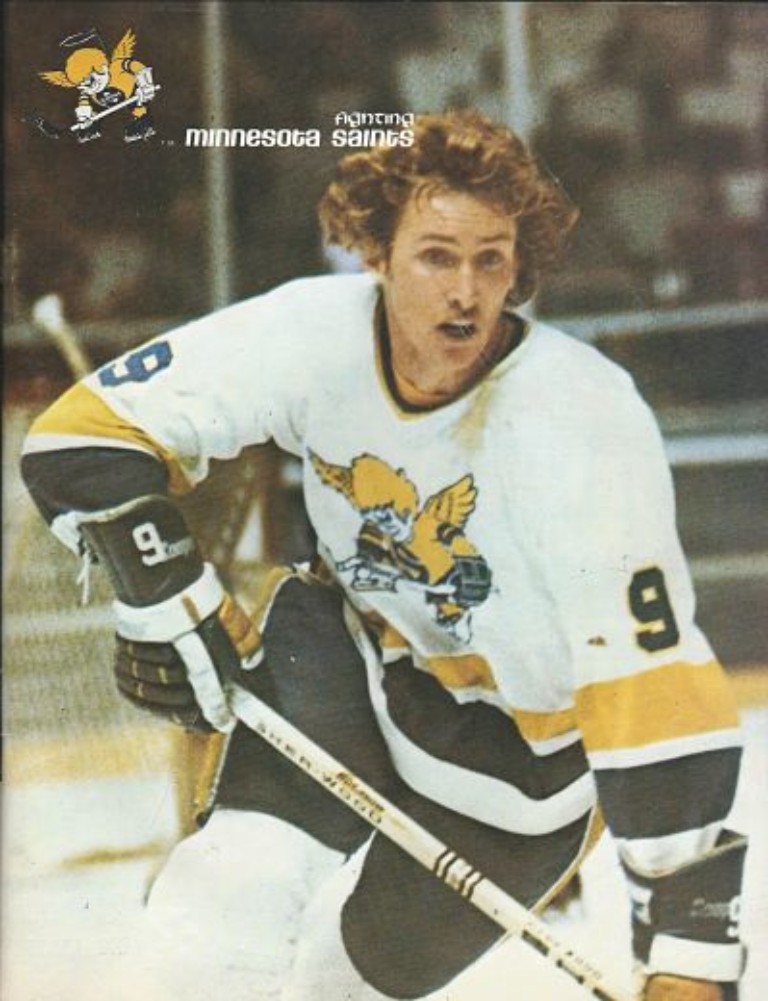
The WHA granted approval to move the team to St. Paul, Minnesota on August 9, 1976.  The Crusaders became the second edition of the Minnesota Fighting Saints, replacing an original WHA franchise the ran out of money and folded during the season in February 1976.   Mileti was never a big money guy in any of his sports dealings – he put deals together with loans and other people’s money.  In St. Paul, Mileti could not find local investors to buy into the club and as a result the “New Fighting Saints” ran out of funds after just a few months play in January 1977.  Minnesota’s WHA franchise folded in mid-season for the second year in a row and that was the end of the franchise that began life as the Cleveland Crusaders in 1972.


==Crusaders Games on Fun While It Lasted==

Season Date Opponent Score Program Other
1972-73 1/30/1973 @ New England Whalers L 4-1 Program
1973-1974 10/23/1973 @ Los Angeles Sharks L 4-3 Program
1973-1974 11/29/1973 @ Quebec Nordiques T 4-4 Program
1973-74 2/9/1974 vs. Toronto Toros W 4-3 Program
1974-75 11/8/1974 @ Vancouver  Blazers W 2-1 Program
1974-1975 11/30/1974 @ Houston Aeros W 5-4 Program
1974-1975 12/28/1974 @ Phoenix Roadrunners L 3-2 (OT) Program
1975-76 11/9/1975 @ Edmonton Oilers L 4-1 Program
1975-76 3/20/1976 vs. Toronto Toros L 6-5 Program


==YouTube==

21 minute featurette on Cleveland Crusaders Hall-of-Fame goaltender Gerry Cheevers.


==Key Players==


==In Memoriam==

Former Crusaders center Bob Dillabough, who skated for the team in the 1972-73 season, died on March 27, 1997 at age 55.


==Links==

World Hockey Association Media Guides

World Hockey Association Programs

###

Written by andycrossley

February 18th, 2013 at 9:41 pm

December 24, 1972 – New England Whalers vs. Los Angeles Sharks

leave a comment

New England Whalers vs. Los Angeles Sharks
December 24, 1972
Boston Garden
World Hockey Association Programs

MERRY CHRISTMAS, Fun While It Lasted readers.

40 years ago this very night here in my hometown…Santa Claus finds time to drop in at the old Boston Garden as the New England Whalers take on the Los Angeles Sharks in World Hockey Association action.

Written by andycrossley

December 25th, 2012 at 3:07 am

October 12, 1972 – New York Raiders vs. Winnipeg Jets

leave a comment

New York Raiders vs. Winnipeg Jets
October 12, 1972
Madison Square Garden
World Hockey Association Programs

Debut game for the ill-fated New York Raiders franchise of the World Hockey Association at Madison Square Garden on October 12, 1972.

The Raiders were supposed to plant the rebel league’s flag in North America’s biggest media market, but things went wrong from day one.  The club hoped to play in the newly opened Nassau Coliseum out on Long Island.  But the NHL outmaneuvered the WHA by fast-tracking an expansion franchise for the building – the New York Islanders – to box out the Raiders.  The Raiders wound up in downtown Manhattan at the costly Madison Square Garden, where they were stuck with garbage dates passed over by the NHL’s New York Rangers and the NBA’s New York Knicks.

An announced crowd of just 6,273 turned out at the 18,000-seat Garden for this first appearance of the Raiders on a Thursday evening in October.  New York’s opening night opponent was the Winnipeg Jets.  The Jets were expected to draw a great crowd because of the presence of Bobby Hull, the erstwhile NHL superstar who put the upstart WHA on the map by jumping to the league for a million dollars in 1972.  But the NHL retaliated with a lawsuit and Hull missed the start of the WHA season, including this game, while the matter was resolved.

Hull’s former line mate with Chicago Blackhawks Christian Bordeleau also made the jump to Winnipeg and the WHA.  He took up the slack for the absent Hull, scoring four goals on this night to lead the Jets to a 6-4 victory.  Bobby Sheehan and Ron Ward had two goals each for the Raiders in the losing effort.

Beset with a bad team and a horrible lease, the Raiders owners bailed on the club in the middle of the 1972-73 season.  The Raiders finished out the year as a ward of the league.  They were equally hapless off the ice, finish 6th (and last) in the WHA’s Eastern Division.

New ownership re-organized the team the following season as the New York Golden Blades, once again based out of the Garden.  The same problems took hold, the new owner bailed again, and the team ended up moving to Cherry Hill, New Jersey to finish out the WHA’s second season.

##

The Raiders had a few interesting personalities…

Alton White was one of only two black players in pro hockey in North America is 1972-73.  (The other was Willie O’Ree, the first black man to play in the NHL way back in 1958.  O”Ree was still kicking around in the minor leagues at age 37).  White started the season with the Raiders, but was shipped off the the WHA’s Los Angeles Sharks after only 13 games.  He would score 20 goals for the Sharks during the 1972-73 campaign.

The Raiders original General Manager was long-time baseball executive Marvin Milkes.  Milkes had some notoriety at the time thanks to Jim Bouton’s sensational 1970 best seller Ball Four, a diary of Bouton’s season pitching for the bumbling 1969 Seattle Pilots of Major League Baseball.  Milkes, the Pilot’s General Manager, is portrayed as an officious penny pincherTo the extent that Ball Four tapped into counterculture distrust of the establishment, Milkes was cast in the role of “The Man”.

Pro hockey didn’t work out for Milkes.  He left the team in October 1972, just a few weeks after the Raiders first and only season got under way.  Milkes spent most of the next decade working for a series of failed pro soccer teams and died of a heart attack in a Los Angeles health club  in 1982.

Long-time New York Yankees radio play-by-play man John Sterling called Raiders games on WMCA AM in one of his early broadcasting gigs.

Downloads & Further Reading

Timothy Gassen at the World Hockey Association Hall of Fame has an entertaining interview with former Raiders beat writer Bill Verigan here.


Written by andycrossley

December 1st, 2012 at 8:32 pm

October 1, 1977 – New England Whalers vs. Boston Bruins

2 comments

New England Whalers vs. Boston Bruins
WHA-NHL Exhibition Game
October 1, 1977
Hartford Civic Center
World Hockey Association Programs

Despite a bitter and often litigious business rivalry, teams from the National Hockey League and the upstart World Hockey Association (1972-1979) played 63 inter-league exhibition matches between 1974 and 1978.  Among the WHA clubs, the New England Whalers were the most enthusiastic participant in these contests, appearing in 16 of the 63 WHA-NHL derbies.

But this was the only night the Whalers ever faced their local market foes, the Boston Bruins.  And this would be the only time Bruins deigned to face a WHA squad.  The Bruins, after all, where one of the most strident anti-WHA hardliners during the league merger discussions that stretched throughout the mid-late 1970′s.  A sampling of their grievances and responses…

  • The Bruins were defending Stanley Cup champions when the WHA launched in 1972. The new league promptly raided the B’s roster, plucking away Gerry Cheevers, Ted Green (lured away by the Whalers), Johnny McKenzie and Derek Sanderson.
  • Boston was so hockey mad in 1972 that the city supported two pro teams at the Boston Garden. Weston Adams Jr. controlled the Garden and owned both the Bruins and their top farm club, the Boston Braves.  During the Braves first season in 1971-72, the team drew bigger crowds than some NHL teams.  But the Whalers move into the Garden in 1972 put the Braves out of business within two years.
  • By April 1974, the Whalers owed $50,000 in back rent to Adams and attempted to pull their gear out of the Garden for a playoff game in Springfield, Massachusetts.  Adams barricaded the Whalers’ locker room with the Garden’s Zamboni machine to extract the rent.
  • Paul Mooney replaced Adams as Bruins and Garden President in 1975.  Mooney was an anti-WHA stalwart and helped to scuttle a 1977 merger plan that nearly united the two leagues.

The Whalers always played the NHL tough in these exhibitions.  Most observers considered the NHL to be the superior league, but the Whalers went 9-3-4 in inter-league play.  Just the evening before the Whale beat the New York Rangers 7-4.   This would not be their night though.   The Bruins teed off of Whalers goaltender Cap Raeder for five goals in the first period, courtesy of Dave Forbes, Stan Jonathan, Rick Middleton, Bob Miller and Brad Park.  Cheevers started in net for the Bruins, back from his own three season adventure in the WHA.  The finals score was 5-0 Bruins.

This would be the only time the Whalers and Bruins would meet in the WHA era.  The clubs next met on November 18, 1979 as NHL rivals, after the merger of WHA and NHL finally went through in the summer of 1979 (over the Bruins’ objections, once again).


Written by andycrossley

November 10th, 2012 at 4:54 am

January 7, 1976 – Indiana Pacers vs. Spirits of St. Louis

leave a comment

Indiana Pacers vs. Spirits of St. Louis
January 7, 1976
Market Square Arena
American Basketball Association Programs
64 pages

This gem of a program from the Indiana Pacers dates to the final days of the American Basketball Association in the winter of 1976.  A young artist named Rich Ernsting painted many of the program covers for both the Pacers and the Indianapolis Racers of the World Hockey Association during their 1975-76 seasons.  Both teams played at the newly built Market Square Arena in Indianapolis, opened in 1974.

Ernsting’s portraits typically featured a Pacers or Racers player – or, in the case of the program at below right, a team personality, such as Racers play-by-play man Bob Lamey.

“They were all watercolor paintings on heavy watercolor paper.  I basically had freedom of design to come up with whatever,” Ernsting recalled to FWiL in 2012.  “I wasn’t really a big hockey fan, but I was a huge Pacers fan.  A friend of mine and I saw most home games, sometimes for free with mid-court seats.  There was nothing like the old ABA Pacers.  They were so exciting.”

Ernsting balanced a full-time day job with the task of producing dozens of original art designs for the Pacers and Racers as a nocturnal side job.

“Roger Brown was my favorite player.  I’m very disappointed he isn’t in the Hall of Fame.  I liked <my> Billy Keller cover and Roger Brown as well.  There were several I thought turned out really good.  The coach of the Indianapolis Racers and a couple of their players.  There were also a few that weren’t so good, sometimes because I was just so tired.  It was a pretty hectic schedule I was on. Not enough hours in the day.”

Occasionally Ernsting’s cover art highlighted a star player from the opposition, such as this illustration of Spirits of St. Louis star Don Chaney from a January 7, 1976 Pacers vs. Spirits game in Indianapolis.

Chaney led an interesting career, entering the NBA as a 1st round draft pick of the Boston Celtics in 1968.  An ace defensive player, Chaney would win NBA titles with Boston in 1969 and again in 1974.  In September 1974, Chaney signed a contract to jump to the ABA for the 1975-76 season after playing out his option year with Boston.  Although other high profile NBA veterans jumped to the ABA in the past – Rick Barry, Billy Cunningham, Zelmo Beatty – Chaney was the first to leave a defending NBA championship team to join the junior circuit.  The Spirits lured Chaney away with a reported offer of $100,000 annually, nearly double the $60,000 salary Chaney drew from the Celtics in 1974-75.

Chaney ended up joining the ABA just in time to witness its death throes.  Two clubs – the San Diego Sails and the Utah Stars – folded during the 1975-76 season.   Chaney’s Spirits wobbled through the season.  The team fired Head Coach Rod Thorn after 47 games and played to microscopic crowds in St. Louis.  At the conclusion of the 1975-76 season, the NBA accepted four ABA clubs in a merger – the Pacers, Denver Nuggets,  New York Nets and San Antonio Spurs.

The NBA didn’t want the ABA’s other three clubs.  The Virginia Squires went out of business and the Kentucky Colonels accepted a modest seven-figure buyout.  In a now infamous deal in NBA lore, Spirits owners Ozzie and Dan Silna negotiated a clever buyout that would pay them a 1/7th share of all NBA television contract money earned by the Pacers, Nuggets, Nets and Spurs in perpetuity.  The Silna brothers owned their ABA franchise for only two seasons.  Nearly four decades later, the Silnas have collected more than aquarter of a billion dollars from the NBA under the terms of this remarkable buyout.  The NBA has looked to extricate itself from the deal for decades without success.

##

Don Chaney would return to the NBA in 1976 after the Spirits folded.  After one season with the Los Angeles Lakers, Chaney returned to the Celtics in 1977 for his final two pro seasons.  He is the only Celtic player to play with both Bill Russell and Larry Bird.

Rich Ernsting has turned his professional interests to photography.  These days he tours the country, photographing college campuses and creating photo collages as keepsakes and remembrances for graduates.  He has photographed over 700 campuses in 48 states and his work can be seen at www.richtraditionsart.com.

Click here for our complete2012 Interview with Program Artist Rich Ernsting

Here are a few more Rich Ernsting program covers from 1975 and 1976:

Written by andycrossley

October 19th, 2012 at 1:43 am

December 9, 1973 – Vancouver Blazers vs. Houston Aeros

leave a comment

Vancouver Blazers vs. Houston Aeros
December 9, 1973
Pacific Coliseum
World Hockey Association Programs
64 pages

When 45-year old Gordie Howe emerged from a two-year retirement to return to the ice in the autumn of 1973, it was not with the Detroit Red Wings, the club he skated for twenty five seasons between 1946 and 1970.  Howe left the Red Wings front office to sign with the Houston Aeros of the upstart World Hockey Association (1972-1979), for reasons both financial and personal.  The Aeros offered a million dollars over four seasons, plus the opportunity to skate alongside his two sons, Mark and Marty Howe.  As with the Winnipeg Jets‘ acquisition of Bobby Hull a year earlier, the Howe signing conferred instant credibility on the second-year league, which was already locked in an expensive with the venerable NHL for talent and expansion markets.

The elder Howe was already a member of The Hockey Hall of Fame, having earned induction in 1972 shortly after his original retirement from the Red Wings.  Opposing teams often marketed Howe’s appearances with the Aeros as main attractions on the annual schedule.  For this December 9, 1973 game against the Vancouver Blazers at Vancouver’s Pacific Coliseum, the local club commissioned artwork of the future Hall-of-Famer for the cover of the evening’s game program.  (The following the season, the mid-year bankruptcy of the WHA’s Detroit-based Michigan Stags franchise would be partially blamed on poor scheduling which delayed Howe’s much anticipated return to Detroit until February, by which point the Stags were out of business).

Howe was everything the Aeros expected and more.  During his first two seasons in Houston, Howe and his sons led the Aeros to back-to-back AVCO World Trophies as WHA champions.  In his first WHA season in the winter of 1973-74, the 46-year old Howe scored 100 points and won the Gary L. Davidson Trophy as league MVP, an award which was subsequently renamed in Howe’s honor the following year.

Howe’s four-year Aeros contract elapsed in 1977.  Howe and his sons moved on to the WHA’s New England Whalers.  The Aeros would survive only one additional season without the Howes, folding in July 1978.

At age 50, Gordie Howe led the New England Whalers in scoring with 96 points during the 1977-78 season and led the club back to the WHA championship series.  The Whalers were one of four WHA clubs allowed to join the NHL in 1979 with the demise of the WHA, and Howe played a final pro season – his 32nd – at age 51 in the winter of 1979-80.  Remarkably, he played in all 80 games that season.

In 1997 the Detroit Vipers of the minor league International Hockey League signed Howe – then aged 69 – to a one-day contract.  Howe skated a single 47-second shift for the Vipers on October 3, 1997 against the Kansas City Blades and became the first (and obviously only) player to play pro hockey in six different decades.


Written by andycrossley

June 25th, 2012 at 12:50 am

January 28, 1979 – New England Whalers vs. Winnipeg Jets

leave a comment

New England Whalers vs. Winnipeg Jets
January 28, 1979
The Springfield Civic Center
World Hockey Association Programs
64 pages

New England Whalers left winger Jack Carlson is pictured on this January 1979 program from the dying days of the World Hockey Association (1972-1979).  I received several of these old Whalers “Blue Line” game programs in the mail this week, but chose this one for FWiL because of Carlson’s storyline.

Jack Carlson was one of a trio of hockey playing brothers along with siblings Jeff and Steve, all of whom spent some time in either the WHA or the NHL during their journeymen careers.  All three Carlsons played on the 1974-75 Johnstown (PA) Jets of the minor North American Hockey League during the mid-1970′s, alongside a 23-year old winger named Ned Dowd.  Dowd’s sister Nancy was a budding screenwriter and he provided her with the source material for her breakthrough screenplay, Slap Shot.  The Carlson brothers inspired – and were cast as – the “Hanson Brothers” in Slap Shot, a trio of child-like goons who help transform the fortunes of Paul Newman’s fictitious Charlestown Chiefs in the film.  Steve and Jeff have considerable screen time in the film, but Jack Carlson had to drop out of filming after received a call-up to the Edmonton Oilers of the WHA.  He was replaced by his former Jets teammate, Dave Hanson.

Here’s Jack Carlson in some Hanson-brothers style action with the Whalers in 1978:

The Whalers beat the Winnipeg Jets 8-6 in a high scoring shootout on this January evening in 1979.  Today most hockey fans associate the Whalers with Hartford, Connecticut, where the team played a majority of its WHA-era games during the Seventies.  (Less than two months after this game, the Whalers were one of four WHA clubs accepted into the NHL for the 1979-80 season and formally changed their name to the “Hartford” Whalers).  But the Whalers played the entire 1978-79 season at the Springfield Civic Center due to a January 1978 roof collapse that knocked the Hartford Civic Center out of commission for two full years.

This game was also one of Jack Carlson’s final games as a Whaler after the better part of three years with the team.  Four days later he was sent to the Minnesota North Stars of the NHL as part of an inter-league trade.  Carlson made his final pro appearances with the North Stars during the 1986-87 season at the age of 32.

Jack Carlson’s career statistics on HockeyDB.com


Written by andycrossley

June 3rd, 2012 at 4:03 am

January 30, 1973 – New England Whalers vs. Cleveland Crusaders

leave a comment

New England Whalers vs. Cleveland Crusaders
January 30, 1973
The Boston Garden
World Hockey Association Programs
56 Pages

I’m headed in to the TD Garden in Boston this evening for a charity event at tonight’s Bruins vs. Washington Capitals game.  Bostonians over 30 like me still call it “the New Garden”, giving the 16-year old building its rightfully subordinate place beneath the revered Boston Garden of our youth – the smoky, steep sweatbox with loads of obstructed view seats that was demolished in 1997.

For a couple of winters in the early 1970′s the Bruins shared the Garden with their mortal rivals – the New England Whalers of the World Hockey Association.   The existence of the WHA created a form of de facto free agency for NHL players who were previously bound to their teams by the reserve clause.  More than 60 NHL players jumped to the WHA for the league’s debut season in the winter of 1972-73.  The Bruins lost their scoring star Derek Sanderson who signed a five-year, $2.6 million deal with the Philadelphia Blazers that briefly made him the highest paid athlete on Earth.

But the WHA’s biggest coup was signing Chicago Blackhawks star Bobby Hull to a ten-year deal prior to the 1972 season.  “The Golden Jet” would play for the WHA’s Winnipeg Jets franchise, whose name was inspired by the superstar himself.  Hull became the face of the WHA for marketing purposes, to the point where he is pictured smiling on the cover of this January 30th, 1973 New England Whalers program, even though the Whalers foe that night was not Hull’s Jets, but rather the Cleveland Crusaders.

The Whalers played two years at Garden from 1972 to 1974 before moving to the newly opened Hartford Civic Center for the 1974-75 season.  The Whalers were one of four WHA clubs accepted into the NHL for a $6 million expansion fee in a merger between the two leagues in 1979.  Known as the Hartford Whalers from 1979 to 1997, the club moved south in 1997 and is today known as the Carolina Hurricanes.

Here is a some great video of Hull getting after the Chicago Cougars in the WHA days…


Written by andycrossley

March 29th, 2012 at 4:37 pm