A near capacity crowd of 3,574 curious spectators turned out at Boston University’s Walter Brown Arena on May 9th, 1974 to watch the local debut of America’s newest sporting novelty – World Team Tennis. The idea of World Team Tennis was to take the sport out of stuffy country clubs and re-package it as a team sport played in giant hockey arenas, complete with rowdy fans, cheerleaders and pop music blaring over the speakers.
16 clubs saw action for the league’s debut season in the summer of 1974. Many of the team identities were bland references to tennis lingo and equipment (Chicago Aces, Cleveland Nets, Denver Racquets, New York Sets). The Boston Lobsters were easily the cleverest of this bunch. The Lobsters opponents on this night, the Hawaii Leis, took another path and doubled down on the sexual entendre. Before relocating to Honolulu, the franchise was originally going to be called the San Diego Swingers.
This early season match was one of only a handful played under WTT’s original scoring system. Each match consisted of two halves. Both halves consisted of one set of women’s singles, men’s singled and mixed doubles. Players could compete in two different sets in a match, but only in one set per half. WTT further rankled tennis purists by getting rid of the traditional love-15-30-40 scoring system and replacing it with a simpler “no-ad” system. Scoring was just 1-2-3-4 with the first player to four points winning the game.
Two weeks into the 1974 season, it was clear the format wasn’t working. Matches were slogging along past the three hour mark. WTT officials made a change on the fly, scrapping the “halves” format with its six sets. The new scoring system saw a shortened format of five sets – one each in men’s and women’s singles, men’s and women’s doubles, and mixed doubles. This hasty revision is the format WTT still uses today nearly forty years later.
The Lobsters beat the Leis 33-25 on this night to win their home debut, but a late season collapse led to a losing record of 19-25. Original Lobsters owner Ray Ciccolo, owner of a local Volvo dealership, lost $300,000 on the 1974 season and the club went into bankruptcy. It looked like World Team Tennis was one-and-done in Boston. But in early 1975 a new ownership group led by future New England Patriots owner Robert Kraft bought the Philadelphia Freedoms franchise, moved it to Boston, and revived the Lobsters for the 1975 season. Kraft would own the Lobs until the league’s demise in late 1978.
World Team Tennis went dark for two years in the late 1970′s, but founder Billie Jean Kingrebooted a lower-budget version in 1981 which continues to play today. In 2005, Boston-area businessman Bahar Uttam purchased an expansion franchise in the new World Team Tennis and revived the Boston Lobsters name once again. The modern-day Lobsters continue to play today out of the Ferncroft Country Club in Middleton, Massachusetts.
The San Diego Friars were a franchise in World Team Tennis that played primarily at the San Diego Sports Arena from 1975 to 1978. The Friars also played occasional matches at the Anaheim Convention Center.
The team was best known for signing Rod “The Rocket” Laver in February 1976. The Australian superstar, then 38 years old, is one of the greatest tennis players of all time and the only person ever two have completed two Grand Slams (1962 and 1969). Laver was the world’s #1 ranked male player for seven consecutive years from 1964 to 1970. He played three season for the Friars from 1976 through the club’s final season in 1978.
The Friars were a league doormat in 1975, finishing tied for last place with a 14-30 record. Despite the arrival of Laver, the Friars were even worse in 1976 at 13-31. San Diego finally turned things around in 1978, winning their division at 30-14, the second best record in World Team Tennis. But the club was upset in the first round of the playoffs by a team with a losing record, the Seattle Cascades.
Friars owner Frank Mariani was a close associate of Dr. Jerry Buss, the owner of WTT’s Los Angeles Strings franchise, who later purchased the Los Angeles Lakers and Los Angeles Kings in 1979. Buss and Mariani became key backers of the novelty tennis league. By WTT’s fifth and final season in 1978, the two men controlled or otherwise held stakes in at least four of the league’s ten franchises: Anaheim, Indiana, Los Angeles and San Diego. Buss and Mariani’s decision to pull out of World Team Tennis in November 1978 effectively sunk the league, which had already lost high profile clubs in Boston and New York a month earlier.
A low-budget re-boot of World Team Tennis re-opened for business in 1981. The San Diego Friars name was revived and the “new” Friars played three seasons from 1981 to 1983, without the star power or media exposure of the 1970′s edition.
We recently unearthed this great little collection of material from the final days of World Team Tennis (1974-1978) in Wakefield, Massachusetts. This collector had a “Super Tie-Breaker” game program from the 1978 WTT playoff best-of-five Championship Series between Robert Kraft’sBoston Lobsters and Dr. Jerry Buss’Los Angeles Strings. Billie Jean King, league co-founder and star of the New York Applesfranchise is pictured on the cover.
In addition, he had saved a complete set of game notes, a ticket stub, and a few Lobsters promotional flyers for the playoff series. The series began in Boston at the Walter Brown Arena on the campus of Boston University. And this truly was an attractive promotion for local tennis fans. The Lobsters featured 1978 Wimbledon champion Martina Navratilova. The Strings had the unpredictable, profane and always entertaining player-coach Ilie Nastase and the young American superstar Chris Evert, who had won the women’s singles title at the U.S. Open just one week before this playoff series opened.
The Navratilova-Evert rivalry was just burgeoning and would go on to become the dominant storyline of women’s tennis in the early-mid 1980′s. Unfortunately for Boston tennis lovers, Navratilova injured her shoulder during the U.S. Open and could not participate in either of the first two Championship Series dates in Boston. She was inadequately replaced by 19-year Anne Smith, who was no match for Evert in either match.
The series moved back to Los Angeles for a potentially deciding Game Three on September 19, 1978. A Strings record crowd of 10,366 was on hand. Navratilova played through her tendinitis and gutted out a 7-5 women’s singles set over Evert. Anne Smith and Lobsters player-coach Roy Emerson defeated Nastase and Ann Kiyomura in the deciding mixed doubles match, keeping the Lobsters alive and forcing a Game Four. But the Strings put the series away in Game Four two nights later, earning the fifth and final championship of World Team Tennis before a Forum crowd of 7,154.
##
One month later, Robert Kraft folded the Lobsters on the same day that New York Apples ownerSol Berg folded his club. Buss followed two weeks later, shutting down the Strings in early November 1978, despite setting a league attendance record and winning the league championship. The entire league was more or less kaput by Thanksgiving, ending one of the quirkier professional sports experiments of the 1970′s.
Billie Jean King was still sold on the concept of Team Tennis and revived the league in 1981. It continues to play today, although in much smaller country club venues (compared to the big NBA and NHL arenas of the 1970′s league) and with much less media coverage.
The venerable sports memorabilia dealer Phil Regli unearthed a rare trove of old World Team Tennis (1974-1978) media guides for Fun While It Lasted recently. I was psyched to find a couple of guides from my hometown team, the Boston Lobsters, including this 1978 guide (at right) from the Lobsters final season with Czechoslovakian superstar Martina Navratilova on the cover. Navratilova played for the Lobs in 1977 and 1978 when….well, we’re getting ahead of ourselves here.
The Lobsters came ashore in late 1973 as one of 16 founding franchises in World Team Tennis. WTT played a May-August schedule, with a mid-season break for Wimbledon. The goal of the league was to attract the top men’s and women’s players from around the world during a relatively quiet time in the tour schedule and group them into geographic franchises, like in the major American team sports. Tennis fans who came to see matches in the big hockey arenas that WTT favored like the Philadelphia Spectrum and the Nassau Coliseum were encouraged to behave in very un-tennis like ways, hooting at cheerleaders and loudly booing opponents and officials. Pro tennis without the stuffiness.
Boston auto dealer Ray Ciccolo founded the Lobsters in 1973 and was the owner for the first season. The team did not feature major stars that first summer of 1974, with Australian Kerry Melville – ranked #6 in the world at the time – probably the biggest “name”. (Melville would later marry one of her Lobsters teammates – Grover “Raz” Reid).
The Lobsters debuted in Boston on May 9, 1974 against the Hawaii Leis, before a just-short-of-capacity crowd of 3,574 at Boston University’s Walter Brown Arena. A post-Wimbledon slump knock the Lobs out of playoff contention and they finished with a 19-25 record. For the inaugural season the Lobsters averaged 2,564 paid tickets for 22 home dates and also managed to broadcast matches on local television.
That wasn’t enough to keep Ciccolo’s team solvent. The young auto dealer lost a reported $300,000 operating the Lobsters in 1974. Boston was one of several shaky franchises revoked by the league during the offseason. New investors were eventually found in March 1975, just two months short of WTT’s sophomore campaign. By this point it was too late to revive the bankrupt club whose players had already been dispersed to other teams, so technically the original Boston Lobsters folded after one season. The new investors then bought another WTT club, the Philadelphia Freedoms, moved it to Boston and re-launched the Lobsters.
The Lobsters really came into their own under the ownership of young paper products magnate Robert Kraft. Yes, that Robert Kraft, who would later go on to rescue the floundering New England Patriots and build the team into a three-time Super Bowl champion valued at over $1 billion. Kraft took over control of the team in 1975 and the team muddled through two more losing seasons on the court, including a last place finish in 1976.
But club’s fortunes turned in 1977 when the Lobsters signed the 20-year Czech defector Navratilova and brought in tennis legend Roy Emerson as player/coach. Emerson won every Grand Slam men’s singles title at least once during the 1960′s, including six Australian Open titles in his native country. Under Emerson, the Lobsters finished 1977 with a league best 35-9 record. Navratilova was the #1 women’s singles player in the league and teamed with South African Greer Stevens to form the league’s strongest women’s doubles duo. However, the Lobsters would lose to the defending champion New York Apples in the WTT playoff semi-finals in 1977.
The Lobsters were a top WTT club in 1978 and this year they finally made it all the way to the WTT championship series in September against the star-studded Los Angeles Strings, led by Ilie Nastase and Chris Evert. Like the Lobsters with Robert Kraft, the Strings were owned by a novice sports owner – real estate investor Jerry Buss – who would shortly become a major pro sports mogul. Buss would buy the Los Angeles Lakers and Los Angeles Kings from Jack Kent Cooke the following year and was at the helm of the Lakers dynasties of the 1980′s and 2000′s. The Strings got the best of the Lobsters in 1978, winning the fifth and final championship of the original World Team Tennis.
Robert Kraft folded the Lobsters on October 27, 1978, in tandem with New York Apples owner Sol Berg. Kraft and Berg cited the league’s inability or unwillingness to continue to sign the world’s best players as their reason for withdrawing. Buss – who directly or indirectly controlled four WTT clubs – followed suit a month later and World Team Tennis was out of business by Christmas 1978.
A smaller, less ambitious version of TeamTennis relaunched quietly in California only in 1981. As with the original league, Billie Jean King was at the helm, as both player, executive and spokesperson, along with her husband/business partner Larry King. This revived league continues to exist today and has spread across the country.
In 2005 Boston-area businessman Bahar Uttam purchased an expansion franchise in the new league and revived the Boston Lobsters name. The modern day Lobsters continue to play each summer at Joan Norton Stadium at the Ferncroft Country Club in Middleton, Massachusetts.
The New York Sets/Apples were a pro tennis franchise active in Manhattan from 1974 to 1978. The club was active for all five season of World Team Tennis (1974-1978), a funky little organization that attempted to graft the classic tropes of American professional team sports (team scoring, standings, cheerleaders, booing and cheering) onto the hushed, snooty atmosphere of the pro tennis tour. The league was founded in 1973 by serial sports entrepreneur Dennis Murphy in partnership with the game’s greatest female star, Billie Jean King, her husband/business partner Larry King, and a few others investors.
Jerry Saperstein, son of Harlem Globetrotters founder Abe Saperstein, originally held the New York franchise but quickly sold it off to Sol Berg. WTT owners were inexplicably enamored with team names relating to the rules and equipment of the game. Loves, Nets, Racquets and Strings were among franchise monikers. New York ended up with one of the dullest and least imaginative – the New York Sets.
The Sets debuted on May 7, 1974, losing to the Hawaii Leis before an announced crowd of 4,990 at Long Island’s Nassau Coliseum. Under WTT’s novel scoring system, each match consisted of five sets – one each of men’s singles and doubles, women’s singles and doubles, and mixed doubles. There were no love or advantages – each game of a set was simply scored zero, 1, 2, 3, game. Match scoring was simply the cumulative games won from each of the five sets.
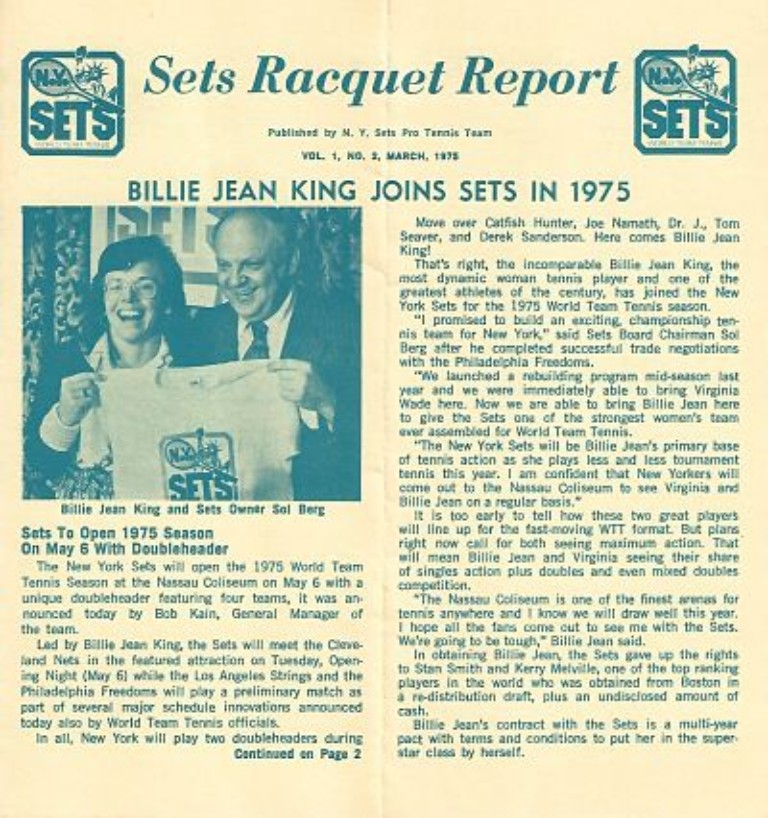
The Sets finished in the cellar in 1974 with a 15-29 record. Fans were largely indifferent – the club drew an average of just 2,869 for 22 home dates during the summer. But the Sets’ fortunes changed in February 1975 when the Sets traded for league founder Billie Jean King, whose Philadelphia Freedoms franchise was about to go under. King, still a formidable player at age 31, made the team an immediate contender. The Sets made the playoffs in 1975 and won the World Team Tennis championship in 1976, sweeping the Oakland-based Golden Gaters. The decisive match drew 5,730 to the Nassau Coliseum in late August.
In 1977 the club moved into Manhattan, splitting dates between the 17,800-seat Madison Square Garden and the more intimate 3,700-seat Felt Forum tucked inside the Garden. To celebrate the move, the club also re-branded, dropping the dreadful “Sets” nickname and becoming the New York Apples for the 1977 season.
The Garden was favored for bigger matches, such as a June 6, 1977 match against the Phoenix Racquets which showcased the two biggest stars of the women’s pro tour: Billie Jean King of the Sets and Chris Evert of the Racquets. The match drew a league record 13,675 fans. The Apples repeated as WTT champions in 1977 and attendance surged 38% with the move to Manhattan, topping 100,000 for the season and an average of 4,939 per match.
For the 1978 season, the Apples added a male superstar to pair with King, adding 23-year old Vitas Gerulaitis, who ranked as one of the top five males in the world at the time. The Apples also added a 21-year old rookie out of Douglaston, New York named Mary Carillo. Carillo would go on to become one of the great broadcasters of tennis and a highly respected reporter on HBO’s Real Sports and NBC’s Olympics coverage in the 1990′s and 2000′s.
There would be no third straight title for the Apples in 1978. The New Yorkers ran into another star-studded team in the playoff semi-finals – the Los Angeles Strings led by Evert and the temperamental Romanian Ilie Nastase. Here JoAnneRussell of the Apples takes on Evert in the decisive August 24th, 1978 semi-final match:
The Strings ousted the defending champion Apples on this night and went on to win the final championship of World Team Tennis in September 1978. This televised match turned out to be the final one the Apples franchise ever played. Team owner Sol Berg shutdown the Apples on October 27, 1978 in tandem with Boston Lobsters owner Robert Kraft. Berg and Kraft cited an inability (or unwillingness – it wasn’t totally clear) of WTT owners to sign the biggest stars of the men’s and women’s game as their reason for withdrawing.
Born: 1973 – WTT founding franchise. Died: November 1974 – Loves relocate to Indianapolis, IN.
Arena: Cobo Arena
Team Colors:
Owners: Seymour Brode & Marshall Greenspan
The Detroit Loves were a one-year wonder, active for the inaugural season of World Team Tennis in the summer of 1974. World Team Tennis sought to take the genteel sport of tennis and market it to the American masses in large hockey arenas. Fans were encouraged to boo and cheer loudly. Each match consisted of five sets – one each in men’s and women’s singles, men’s and women’s doubles, and mixed doubles. Each game won was worth a point and teams earned wins and losses in league standings, as with the dominant American team sports leagues of the era.
The Detroit Loves were one of sixteen franchises that began play in the spring of 1974, playing a busy 44-match schedule. The fledgling league was relatively successful in attracting top players from around the world, particularly from the women’s game. The Loves boasted one of the top American females in Rosie Casals, the singles runner-up at the U.S. Open in both 1970 and 1971.
Casals was the top gate attraction on a roster that also included Aussies Phil Dent, Allan Stone and Kerri Harris and Americans Mary-Ann Beattie and Lenny Simpson. Dent would achieve some notoriety later in that summer of 1974, reaching the final of the Australian Open where he lost to Jimmy Connors in what would turn out to be the only Grand Slam singles final of Dent’s career. Simpson was one of the few African-Americans to play World Team Tennis in the 1970′s. The team was highly competitive, finishing first in their division with a 30-14 record, before a disappointing first round playoff exit courtesy of the Pittsburgh Triangles.
The Loves fared poorly at the gate, attracting a disappointing announced crowd of 3,600 to their home debut on May 9th, 1974 at the 11,000-seat Cobo Arena in downtown Detroit. Crowds for the season hovered around the 2,000 mark in the big building, according to The Associated Press, and the club lost a reported $300,000 on operations for the lone season of play. In November 1974, Loves owners Seymour Brode and Marshall Greenspan sold the franchise to Indianapolis tennis promoter William Bereman who relocated it to that city’s Market Square Arena.
The Loves continued in Indianapolis as the Indiana Loves for four seasons (1975-1978) before folding along with the rest of the league in November 1978.
Any material from the Detroit Loves lone season is exceptionally scarce, but we were lucky to dig up these rare 8″ x 10″ glossy PR stills in a collection a few months back.
Rare match program from the final season of the original World Team Tennis (1974-1978), Billie Jean King’s oddball co-ed tennis league that haunted the nation’s hockey arenas for five summers in the mid-1970′s.
This June 16, 1978 match pitted the Indiana Loves against the Phoenix Racquets at Market Square Arena in Indianapolis. The night marked the return to Indianapolis of Racquets players Sue Barker and Syd Ball,who both played for the Loves in 1977. Barker, 20, of England won the 1976 French Open before signing on with World Team Tennis. True to the Indiana Loves brand name, she went head over heels for Ball, her 26-year old Australian teammate during the 1977 WTT season. At the end of the season, Barker and Ball asked Loves management to package them together should the team consider trading either one of them. In the winter before the 1978 season, the couple announced their engagement and were traded together to the Phoenix Racquets.
Can’t find any record of whether the pair ever did marry, but by the early 1980′s Barker was linked romantically to the English pop star Cliff Richard.
The Loves had a strong Australian connection that summer. Indiana’s formidable 1978 trio of Aussies – Player/Coach Allan Stone, Geoff Masters and Dianne Fromholtz – all won Grand Slam doubles titles during 1977. Before arriving in Indiana, Fromholtz was the subject of another World Team Tennis love connection. While playing for the league’s Los Angeles Strings, she was briefly engaged to Johnny Buss, son of the Strings’ owner Dr. Jerry Buss (yes, the future owner of the Lakers and the Kings). But Fromholtz’s engagement to the son didn’t prevent the father from trading her away to San Diego.
After the 1978 WTT season concluded, eight of the league’s ten franchises folded, citing cumulative losses of $30 million over five seasons. The Loves were among the casualties, throwing in the towel on November 9th, 1978. The league folded shortly thereafter.
##
Loves President William Bereman passed away young at the age of 54 in April 1996.
Billie Jean King helped launch a lower-budget re-boot of World Team Tennis in 1981 and that league continues to muddle along in quiet respectability more than thirty years later. One big difference: the World Team Tennis franchises of today play at small country club stadiums rather than the 15,000-seat hockey arenas of the 1970′s league.
On September 20th, 1973, the Houston Astrodome played host to the “Battle of the Sexes”, a brilliantly executed tennis promotion pitting 55-year old former World No. 1 Bobby Riggs against 29-year old Billie Jean King, the top-ranked female player in the world in 1971 and 1972. The three-set contest was actually something of a rematch as Riggs had previously defeated Margaret Court, the 1973 women’s #1, in Battle of the Sexes I, a match which is now largely forgotten.
Riggs played the role of the heel, wearing a warm-up suit emblazoned with the slogan “Men’s Lib” and hyping the match with chauvinistic comments to the media. King took a more earnest approach, believing that a loss to Riggs following Court’s defeat would set back the development of the women’s tennis tour and women’s sports in general for years. King wasn’t entirely without a sense of humor – she entered the Astrodome on a throne held aloft by shirtless men in Egyptain slave garb. She also smoked Riggs in three straight sets, running the old man from end to end of the baseline.
For all of its pro wrestling-style theatrics, the Battle of the Sexes is regarded nearly 40 years later as a game-changing moment in the advancement of women’s pro sports, occuring just over a year after the U.S. Congress passed the landmark Title IX legislation which changed the landscape of women’s scholastic athletics. The promotion also helped raise the profile another initiative that King was at work on in late 1973 – the controversial launch of World Team Tennis.
World Team Tennis conceived of tennis as a co-ed team sport played in major hockey arenas across the United States. Each contest consisted of five matches – a single set of men’s and women’s singles, men’s and women’s doubles, and mixed doubles. Each game won equated to a point and cumulative team points determined the winner. King’s husband Larry King was one of the league’s founders and King herself served as promotional front woman and top female star.
Houston itself was set to receive one of the sixteen franchises scheduled to begin play in May 1974. The Houston E-Z Riders took their name from the team’s financial backer, oilman E.Z. Jones. The Riders’ logo was a brilliantly goofy ripoff of Yosemite Sam, with the mustachioed outlaw drawing a pair of smoking tennis racquets from his hip holsters.
In late 1973, the E-Z Riders signed Australian men’s star John Newcombe to a five-year contract. The Newcombe signing was a breakthrough for World Team Tennis, because the Association of Tennis Professionals (ATP), the recently formed men’s player union, was staunchly opposed to its members departing the international touring schedule to play a 44-game team tennis between May and August each summer. Newcombe was the first to buck the union and opened the door for (some of) the top male players to sign on with World Team Tennis, including Jimmy Connors in 1974 and later Bjorn Borg, Vitas Gerulaitis and Ilie Nastase.
Other notable E-Z Riders included 23-year old American Dick Stockton, who made it to the Wimbledon semi-finals in 1974 in the midst of the E-Z Riders season, and Australian Helen Gourlay, a doubles specialist who nevertheless attained the 1971 French Open final as a singles player.
The E-Z Riders played most of their 22 home matches at the Sam Houston Coliseum, with four 1974 dates also scheduled at HemisFair Arena in San Antonio. The E-Z Riders finished with a 25-19 record in 1974, good enough to qualify for the World Team Tennis playoffs. In the opening round, the Minnesota Buckskins eliminated the E-Z Riders, ending what would turnout to be the franchise’s only season.
World Team Tennis wobbled badly in the winter following its debut season. The league contracted from 16 to 11 franchises. At first, Houston seemed to be one of the survivors, announcing a move from the Sam Houston Coliseum to the recently constructed Astro Arena. But the club fell behind in its financial obligations to the league. On the opening weekend of the the 1975 World Team Tennis schedule – and just ten days before their own season opener set for May 12th – the E-Z Riders suspended operations on May 2nd, 1975. The announcement was that the team would sit out the 1975 season and re-organize for a future revival, but as often happens the E-Z Riders were never heard from again.
##
The original World Team Tennis lasted for five seasons, eventually folding following the 1978 season. A lower-budget revival of World Team Tennis launched in 1981, again with Billie Jean King’s involvement, and continues going strong to this day.
World Team Tennis launched in 1974, intent on bringing top flight tennis out of the polite confines of the country clubs and into America’s raucous hockey and basketball palaces. Founders Dennis Murphy, Jordan Kaiser and Larry King (husband of league front woman Billie Jean King) sought to sell the product through a combination of star power, promotional gimmickry and nods to established team sports tropes.
Matches took place on candy-colored courts. Organizers encouraged fans to cheer loudly during rallies and to heckle opponents. World Team Tennis introduced a co-ed team sports league to the national sporting scene, drafting off the sensational publicity from the previous year’s “Battle of the Sexes” tennis exhibition between Bobby Riggs and WTT’s marquee star, Billie Jean King.
Teams were composed of three men and three women, playing two sets each of men’s and women’s singles and two sets of mixed doubles. (This format was quickly abandoned after early matches dragged on for up to four hours, replaced by a five-set format, featuring one set each of men’s and women’s singles, men’s and women’s doubles, and mixed doubles). The league featured a simplified “no-ad” scoring system meant to appeal to a broader swath of American sports fans, with 4 points winning a game, rather than the traditional Love-15-30-40 scoring familiar to tennis enthusiasts.
Some of the innovations didn’t sit well with Dennis Ralston, the U.S. Davis Cup captain and traditionalist player/coach of the Hawaii Leis, one of sixteen World Team Tennis franchises that debuted in May of 1974.
“Tennis is not like baseball,” Ralston complained to The Associated Press after one month of play in June 1974. “In Philadelphia and Baltimore, people would yell ‘Miss it!’ when you were serving and the announcers encourage them…pretty soon people will start throwing bottles.”
The Leis were owned by Don Kelleher, a lumber salesman from San Rafael, California. Home matches took place at the 7,500-seat Honolulu International Center as well as the gym at Honolulu’s McKinley High School. The 1974 edition of the Leis finished last in World Team Tennis’ Pacific Division with a 14-30 record. In the 16-team league, only the 13-31 Toronto/Buffalo Royals fared worse. It would be the only time in the three-year history of the lowly Leis that another team finished with a grimmer record.
In April 1975, one month before the start of WTT’s second season, the Leis signed the 32-year old Australian star Margaret Court. Court won all four Grand Slam singles tournaments in 1970, becoming the first of only three women ever to do so. One month later, the Leis got an unexpected opportunity to pair another marquee name with Court when the Houston E-Z Riders franchise abruptly folded on the eve of the season, leaving the league’s biggest male star without an employer. At age 30, Australian John Newcombe owned 23 Grand Slam titles in singles and doubles competition. In 1973, Newcombe had been the first male star to sign a contract with World Team Tennis, defying his Association of Tennis Professionals union which initially opposed its members joining the un-sanctioned league.
But Newcombe struggled through an injury-plagued campaign with the Leis in 1975. In a WTT match against the Pittsburgh Triangles in June, Newcombe tore cartilage in his knee, which caused him to miss Wimbledon. The 1975 Leis finished 14-30 for the second straight year, tied for the worst record in World Team Tennis. Neither Court nor Newcombe would return in 1976.
In December 1975, the Leis inked the combustible 29-year old Romanian Ilie Nastase to a one-year contract for the 1976 season worth a reported $125,000. Nastase’s arrival was a coup for Leis owner Don Kelleher and all of World Team Tennis. The top male players had been somewhat slow to join the league and Nastase was a legitimate superstar and publicity magnet- winner of the 1972 U.S. Open and 1973 French Open and the ATP’s #1 ranked male player for 1973. With Nastase under contract, the Leis cut John Newcombe loose, selling his negotiating rights to the Los Angeles Strings. Meanwhile, Margaret Court retired to have her third child.
Despite Nastase’s presence, the Leis still averaged fewer than 3,000 fans per match during the first half of the 1976 WTT campaign. In early July, Kelleher announced that the team would move six late season matches to Portland, Oregon’s Memorial Coliseum and the Seattle Center Coliseum to test those markets for a potential relocation of the franchise in 1977. The Leis continued to regress on the court, finishing dead last in World Team Tennis’ 10-team format with a 12-32 record. Kelleher made the move to the Pacific Northwest official in a September 1976 press conference, announcing that his club would be known as the Sea-Port Cascades in 1977 while splitting matches between Portland and Seattle.
The 1977 Sea-Port Cascades were a rather unglamorous group. Nastase did not make the move to the Pacific Northwest, signing instead with the Los Angeles Strings. By World Team Tennis’ fourth season in 1977, the league had attracted many of the sport’s top stars, including Bjorn Borg (Cleveland-Pittsburgh), Rod Laver (San Diego), Nastase (Los Angeles), Chris Evert (Phoenix), Martina Navratilova (Boston) and Billie Jean King in New York, alongside the 1977 Wimbledon champion Virginia Wade. The Cascades biggest “name” was the Dutch doubles specialist Betty Stove, who lost to Wade in the 1977 Wimbledon singles final. Tom Gorman of the United States signed on as the Cascades player/coach.
The 1977 Cascades finished 18-26, good enough for fourth place and a franchise first: a playoff appearance. The division-winning Phoenix Racquets, led by Evert, made quick work of the Cascades, dispatching them in the WTT quarterfinals.
Kelleher moved the club to Seattle full-time for the 1978 season and sold minority interests in the team to four area businessmen. The Cascades added one-off appearances to the schedule in Boise, Corvallis and Portland, to go with 19 home dates at the Seattle Center Coliseum. Under Gorman’s direction as player/coach once again, the re-named Seattle Cascades posted a 20-24 record in 1978. It was the franchise’s fifth consecutive losing season dating back to the Hawaii days, but also their best performance and it earned the club its second straight playoff berth. In the quarterfinals, the Cascades upset the division winning San Diego Friars. The Boston Lobsters eliminated the Cascades in the World Team Tennis semi-finals in late August 1978.
After the season, World Team Tennis named Cascades doubles specialist Sherwood Stewart as the league’s most valuable first-year player for 1978. Meanwhile, Kelleher and his Seattle-based minority partners announced the club would not return to Seattle and explored selling the team to Houston interests due to disappointing attendance. The Cascades averaged only 1,695 fans per match in 1978, down from 3,100 per game in 1977 when the club split matches between Portland and Seattle.
The effort became moot when the Cascades and the rest of World Team Tennis folded in November 1978.
##
Former Hawaii Leis Margaret Court, Ilie Nastase and Dennis Ralston have all been inducted into the International Tennis Hall of Fame.
A scaled back version of Team Tennis returned in 1981, with smaller venues, fewer contemporary stars and far less media attention. The league later revived the “World Team Tennis” brand name and continues to play today, typically in country club settings rather than the large hockey and basketball arenas of the 1970′s.
A novelty concept known as World Team Tennis provided the first entry into team ownership for a pair of young investors who would go on to build two of the most successful dynasties ever seen in American sport. Chemist-turned-real estate magnate Dr. Jerry Buss got involved with the league at its inception in 1974, backing the Los Angeles Strings franchise.
The following year, 34-year old Robert Kraft joined with a pair of meatpackers and two other local small businessmen to revive the moribund Boston Lobsters, a bankrupt franchise marked for contraction by World Team Tennis officials. Kraft’s entry into sports ownership could not have been more understated. The only trace that persists in Google’s news archive is a tiny UPI wire story from March 28th, 1975 in the Bangor (ME) Daily News under the heading “Novices to head Hub net franchise“.
The Strings debuted in L.A. on May 15th, 1974, hosting the Florida Flamingos at the Los Angeles Memorial Sports Arena. The Los Angeles Times poked fun at the announced crowd of 4,666, quoting an unnamed spectator as saying “If there are 4,600 people here, 1,500 are dressed as seats.”
In the early years of WTT, other owners and officials overshadowed Buss. The Strings had no stars and performed poorly on the court. New York Sets Player/coach/co-founder Billie Jean King was the face of the league and her husband Larry King served as both Commissioner and co-owner of the San Francisco-based Golden Gaters franchise. Brash Pittsburgh Triangles owner Frank Fuhrer assembled the league’s powerhouse club, signed stars Evonne Goolagong and Vitus Gerulaitis, and attracted national attention for his tirades against league officials and his own players.
In August 1976, towards the end of Strings’ third season, Buss stepped into the spotlight, telling the Associated Press: “You don’t have a great team without a superstar. So…I’m dedicated to getting one because I’m tired of losing.” He then appealed (unsuccessfully) to the American star Jimmy Connors, offering via the media to make him the highest paid player in the league at $200,000 per season.
In March 1977, Buss landed his superstar, signing the mercurial Romanian Ilie Nastase. Nastase signed with the Strings for $1.5 million over six years, along with matching silver Corvettes for himself and his wife. However, the contract included a clause excusing Nastase until after Wimbledon in July 1977. By then, the season was a lost cause and the Strings finished the 1977 campaign buried in last place with an 11-33 record. With four season now in the books, the Strings had yet to post a winning record.
As the fifth season of World Team Tennis dawned in the spring of 1978, a power shift had occurred behind the scenes. While Billie Jean King remained the public face of the league, Buss had emerged as its true power broker. Frank Mariani, Buss’ long-time partner in his real estate concerns, owned the San Diego Friars franchise. Another associate, Larry Noble, ran the Indiana Loves. Buss and Mariani were also involved in the new Anaheim Oranges expansion club. In all, Buss held sway over 40% of the league’s 10 teams.
In February 1978, Buss signed the 23 year-old American superstar Chris Evert, the #1 ranked female player in the world for the years 1975, 1976 and 1977. The star power of Evert and Nastase led the Strings to success on and off the court in 1978. The team posted a winning record of 27-17 for the first time and set an all-time World Team Tennis attendance record, with announced average attendance of 7,219 at the Forum.
In the 1978 WTT playoffs, the Strings dispatched the Golden Gaters and Billie Jean King’s New York Apples . This Youtube clip shows Evert in action against JoAnne Russell of the Apples at the Forum on during the semi-final series, played on the psychedelic World Team Tennis colored court.
On September 21st, 1978, Buss’ Strings played Kraft’s Boston Lobsters at the Forum for the championship of World Team Tennis. After the men’s doubles, men’s singles and mixed doubles matches, the Strings trailed the Lobsters 18-15 with only women’s singles and women’s doubles remaining to determine the league champion. Then Evert took over.
The fourth set pitted 1978 U.S. Open champ Evert against the 1978 Wimbledon titleist Martina Navratilova of the Lobsters in women’s singles. In the 1980′s, Navratilova would come to dominate her famed rivalry with Evert. But in the 1970′s, Evert owned Navratilova, particularly on hard surfaces. This night was no different. Evert needed a tiebreaker to hold off Navratilova in singles, prevailing 7-6 (5-4). Entering women’s doubles – the final set – the Lobsters clung to a 24-22 lead. Evert and partner Ann Kiyomura dominated Navratilova and Anne Smith 6-1 to seal a 28-25 victory and the 1978 World Team Tennis title for the Strings.
On October 27th, 1978 Kraft folded the Lobsters and Sol Berg did the same with his New York Apples franchise, reducing the league to eight teams. Buss followed suit on November 7th, 1978 claiming total losses of $2.7 million over the five seasons that he owned the Strings from 1974 to 1978. Over the next three days, the Buss-affiliated clubs in Indiana, Anaheim and San Diego also shut down, as did franchises in New Orleans and Seattle-Portland. With only San Francisco and Phoenix left standing, World Team Tennis formally ceased operations in March 1979.
##
In May 1979, six months after folding his World Team Tennis interests, Dr. Jerry Buss purchased the Los Angeles Lakers, Los Angeles Kings of the NHL and The Forum from Jack Kent Cooke for $67.5 million. At the time, it was the largest ownership transaction in sports history. Buss owns the Lakers to this day, presiding over two NBA dynasties – the Showtime Lakers of the 1980′s and the Phil Jackson/Kobe Bryant Lakers of the 2000′s, who together have earned ten NBA titles as of this writing. Buss was inducted into the Basketball Hall of Fame in 2010.
Robert Kraft acquired Sullivan Stadium, home of the NFL’s New England Patriots, in 1988. Four years later, he acquired the team itself for a then NFL record price of $175 million. Like Buss, Kraft presided over a dynasty, earning three Super Bowl titles in New England. In 2010, Forbes valued the Patriots at $1.4 billion, making them one of the most valuable sports properties in the world.
Both Buss and Kraft experienced years of red ink in World Team Tennis as tenants in buildings owned by others, observing their landlords generate parking and concessions revenue from WTT events, while the teams bore all of the costs and burdens of promotion. It is instructive to note that both men made acquisition of buildings a centerpiece of the record-setting deals they struck to buy into their subsequent major league investments.
In 1981, a scaled-down TeamTennis relaunched with four teams in California, including a new version of the Los Angeles Strings, once again owned by Buss. Buss handed off management of the team to his 19-year old daughter Jeanie Buss. ”Basically, my dad bought me the team,” Jeanie Buss told Sports Illustrated in 1998. ”It was a very empowering experience.”
Jeanie Buss led the Strings through more than a decade of stable existence in World Team Tennis version 2.0. The Strings – and the new league – never again had the national footprint, ambitions or media coverage of the 1970′s incarnation. But the Strings II did attract several big stars, either moonlighting from the pro tour or using World Team Tennis as a form of senior exhibition tour. Navratilova (1981), Connors (1991-1992) and Bjorn Borg (1993) all spent time with the Strings. A 1993 World Team Tennis match between the Phoenix Smash (featuring Connors) and the Strings (with Borg) drew 7,693 fans to the America West Arena in Phoenix and attracted national coverage from The New York Times. It was the last headline for the Strings who folded quietly after the 1993 season.